
Reviewed · CUENCA DAY TRIPS
Visita Guiada Por El Casco Histórico De Cuenca Y Su Catedral
This guided walk is interesting because it pairs big sights with close-up street level details in Cuenca’s historic center, then tops it off with time inside the Catedral de Cuenca. It also works as a helpful add-on to the city’s night tour, since this daytime route covers different streets and points of view.
I especially like the way the guide packs meaning into each stop, from the story behind the Torre Mangana clocks to what makes the medieval Gothic cathedral so special. I also like that you get more than exterior photos, since entry is included for the San Martín “skyscrapers” look and for the cathedral interior. One drawback to consider is that this is a walking-heavy old town, so comfy shoes matter.
Key Highlights You Get on This Cuenca Walk
- UNESCO historic center on foot, with stops tied to how Cuenca grew and changed
- Torre Mangana for two clock faces and citywide views
- San Martín vertical houses (16th century), with included exterior and interior time
- Catedral de Cuenca interior, including time to see it properly, not just pass by
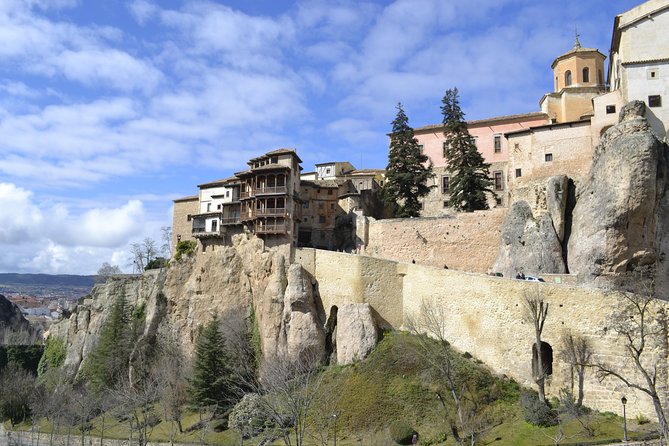
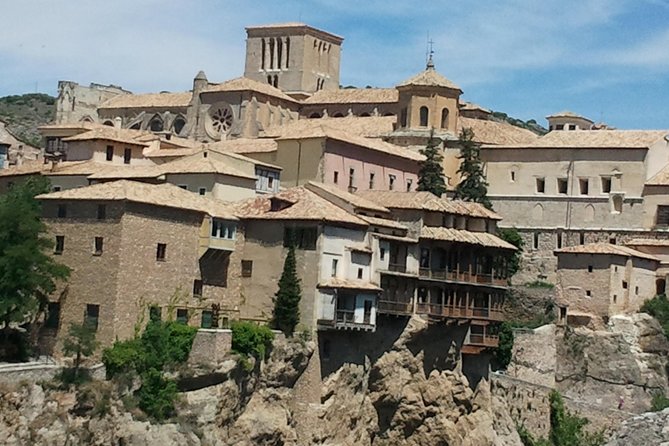
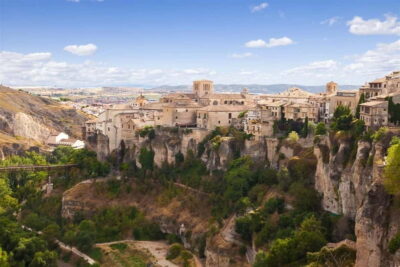
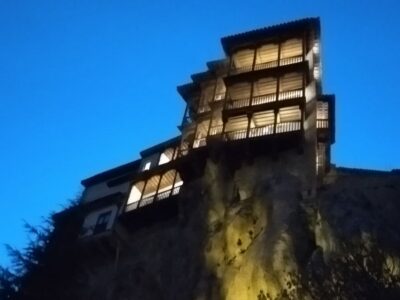
- Casas Colgadas perched above the Hoz del Río Huécar, with memorable wooden balconies
- A route that mixes plazas, towers, churches, and viewpoints without feeling rushed
Why Cuenca’s Old Town Tour Feels Efficient
Cuenca can hit you with the visuals fast, but it is the stories that help everything click. This tour is built to do that. You move street to street through the old city, then pause long enough at the big anchor points to actually notice details.
The price, at about $18.58 per person for roughly 2 hours 15 minutes, is solid value when you factor in what is included. You are not paying extra just to look from outside. You get the cathedral admission and also included entry time for the San Martín houses.
You also travel in a manageable group size, with a maximum of 50 people. That helps the guide keep things organized and keeps questions practical.
More Cuenca day trips from Madrid:
- Cuenca: Medieval Old Town
★ 4.7 · 152 reviews - Night Walking Tour of Medieval Cuenca
★ 5.0 · 64 reviews - Cuenca: Enchanted City and Devil’s Window
★ 4.7 · 57 reviews
Timing and Where You Start (Plus How the Route Ends)
You meet in the morning at C. Alfonso VIII, 1 at 11:30 am, and you finish at Cuenca Cathedral (Pl. Mayor). Starting near Alfonso VIII is convenient because it puts you near the heart of the historic center before the group fans out through the old streets.
The end point matters too. If you want lunch after, you finish in the area where you can continue on foot, rather than disappearing back to a distant hotel zone. It is a simple out-and-back plan in reverse: you begin near the central action and end at the main landmark.
Plan for walking on uneven historic streets, and bring a light layer. Cuenca can feel cool in the shade, and you will be outside for much of the route.
Plaza Mayor de Cuenca and the Faces of the City
Your first stop is Plaza Mayor de Cuenca, framed by colorful facades, many dating to the 16th century. This is one of those squares where you can start spotting patterns in Cuenca’s architecture right away: stone, painted surfaces, and the way buildings crowd close around public space.
What I like here is that the square is not just a backdrop. It sets your visual baseline before you climb into the tower viewpoints and the perched homes later. You also see the baroque facade of the Ayuntamiento and the big presence of the Convento de las Petras.
If there is any early drawback, it is that plazas are sometimes breezy and sunny at the same time. If you are photographing, bring sunglasses and expect to move between bright and shaded street edges quickly.
Plaza de la Merced: Baroque Facades and a More Quiet Pace
Next you head to Plaza de la Merced, described as a neat little square with three baroque facades. This stop slows the pace in a good way. It is a moment to look carefully at the religious buildings around you, including the seminario, the church, and a convent of cloistered life.
The practical value of this stop is that it helps you understand Cuenca’s old town as more than monuments. It is also daily life anchored by institutions, neighborhoods, and the long timeline of churches and seminaries.
When you arrive, take a few seconds to look at height and symmetry across the facades. The guide’s explanations help you see what you would otherwise treat as purely decorative.
Still in Cuenca, a different sort of afternoon:
- guided night tour
★ 5.0 · 176 reviews - Excursion to the Enchanted City
★ 5.0 · 90 reviews - Monumental Basin Day Guided Tour
★ 5.0 · 67 reviews - Guided Walking Tour of Cuenca
★ 4.5 · 52 reviews
Torre Mangana: The Clocks That Give You Bearings
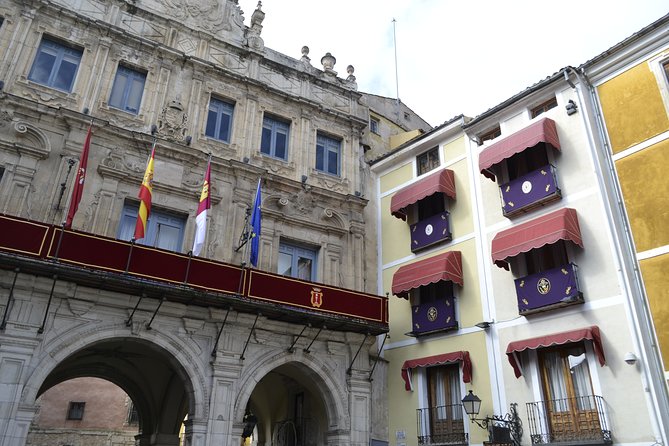
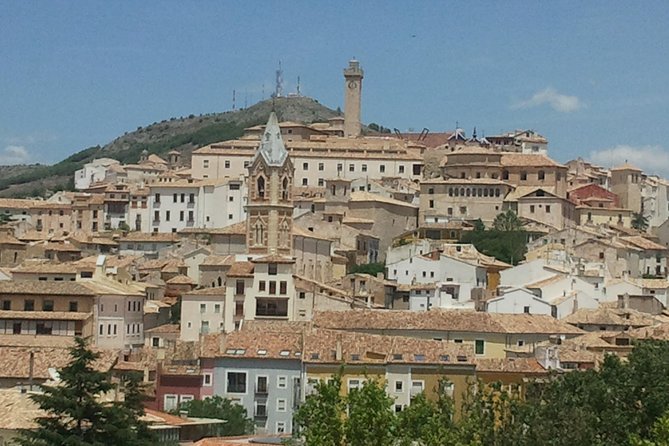
Then comes one of the most satisfying “wait, wow” stops in the whole walk: Torre Mangana. It is a beautiful 16th-century tower with two clocks near the top.
But the best part is not the tower alone. It is the viewpoint. From here you can get citywide context, so later stops stop feeling random. You start to recognize where the houses cling to the ravine, how the plazas connect, and how the cathedral sits as a center of gravity for the old town.
The consideration is simple: viewpoint time depends on conditions. If it is windy or you cannot stand comfortably for a while, you might want to pace yourself and keep your phone strap handy for steady photos.
San Martín “Skyscrapers” (16th-Century Vertical Homes) With Inside Time
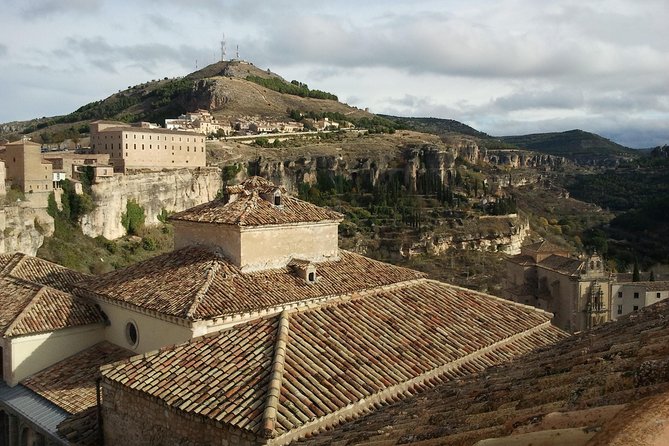
One of the main reasons to pick this tour is San Martín, where you visit the interior and exterior of Cuenca’s tallest houses in Europe in the 16th century, with 12 heights. The operator specifically emphasizes that they show the interior of these buildings, not just the outside view.
You get about 5 minutes focused on this stop, with a ticket included. Five minutes sounds short, but it is the kind of short that works because the guide is likely directing your attention to the features that matter: layout, how the structure meets the slope and the street, and what “vertical living” meant in that era.
This is the place where the tour turns from sightseeing into understanding. When you look at these buildings close up, you start to realize why Cuenca’s old town feels so dramatic and why it has become such a standout UNESCO example.
Convento de San Pablo: The Parador Built on a Cliff Edge
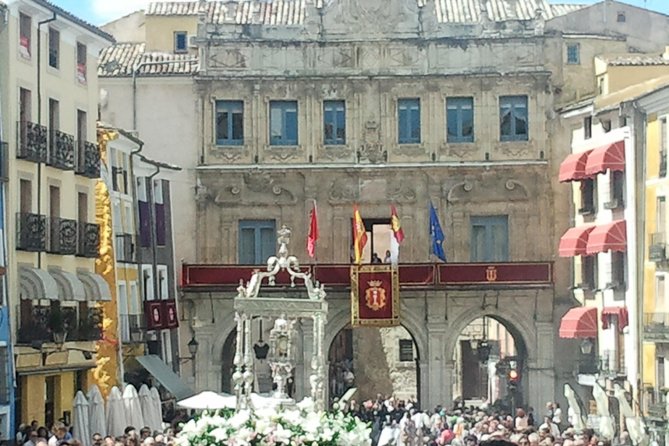
After the vertical houses, you shift to Convento de San Pablo, which is now an actual Parador. The surprise here is location. The convent sits near the edge of a dramatic drop, and the setting is part of what makes the building memorable.
I like this stop because it gives you a different kind of perspective after all the stone facades and tight streets. You get a wider sense of the city’s geography, and you feel how the ravines shape where people built.
If you are sensitive to heights, take your time near the edges and keep your footing careful. Even without extreme exposure, the setting makes people subconsciously rush.
Puente de San Pablo: Iron Crossings and What Was Replaced
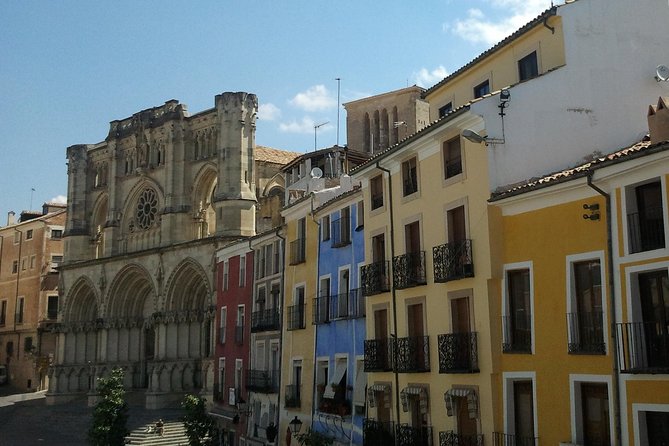
Then you reach Puente de San Pablo, a 1903 iron bridge that replaced an earlier stone bridge. The interesting part is that you can still see some fragments of the original stone.
This stop is worth it because it shows how Cuenca balances preservation with modernization. You are not just seeing old buildings. You are seeing how the city adapted when bridges needed to change.
One practical note: bridges are windy spots. If your hair or hat moves easily, plan for that, and keep your phone securely tucked when the breeze kicks up.
Casas Colgadas: Noble Homes Over the Huécar Ravine
Next up is Casas Colgadas, the famous noble homes that hang over the Hoz del Río Huécar. The key visual here is the series of impressive wooden balconies sticking out over the ravine.
This stop earns its fame because it looks like it should not be possible, and the guide’s explanations give it sense. You start thinking about engineering and design, not just photos.
For best results, slow down. Let your eyes travel along the wooden balconies and then back up to the upper facades. When you do that, you notice how the shapes repeat and how the city’s layout creates a natural viewpoint.
Alfonso VIII Statue: A King’s Legacy in Bronze
You also stop at the bronze sculpture of Alfonso VIII, the king of Castile for 44 years. The guide connects him to a turning point story, including his victory in the Battle of Las Navas de Tolosa, which changed the course of Spanish history.
This is a small stop, but it matters for context. Without it, you might see monuments as random decoration. With it, you see why public art and names show up again and again in Cuenca’s old streets.
If you are not a big sculpture person, take this moment anyway. It is quick, and it helps you connect the cathedral and major sites to the long timeline of the region.
Catedral de Cuenca: First Gothic Cathedral in Spain, With Time to Look
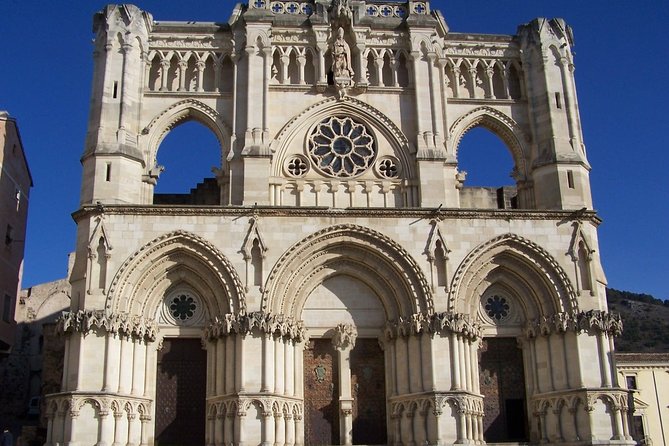
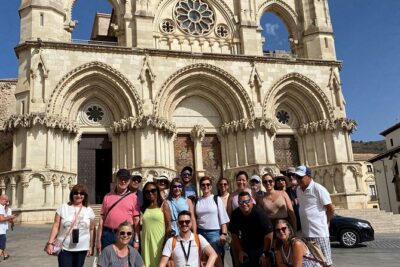
The finale is Catedral de Cuenca, noted as the first Gothic cathedral in Spain and one of the most striking. You get about 35 minutes here, and admission is included, so you can plan on doing more than peek.
This is where the tour justifies its focus. Cuenca’s skyline views are amazing, but a cathedral is a different kind of experience. In 35 minutes, you can actually slow down, look for the structure’s Gothic rhythm, and notice how the interior feels compared to the outside stonework you saw earlier.
What I like about ending here is that the cathedral feels like a natural conclusion. You have spent time learning how Cuenca’s neighborhoods and religious buildings fit together, and then you step inside the landmark that ties that story into architecture.
How Price, Group Size, and Inclusions Add Up
Let’s talk value in a practical way. At $18.58 for about 2 hours 15 minutes, you are paying for two things: guided interpretation and paid access to key interiors.
Here’s what is included by the tour design:
- San Martín houses: included admission and a short but focused interior/exterior look
- Catedral de Cuenca: included entry, with 35 minutes inside
A lot of walking tours around Europe are basically a route plus a voice. This one includes entry at the moments where it matters. That makes your time count.
Group size also affects value. With a cap of 50, you should still feel guided rather than just streamed through checkpoints.
Is This Tour Right for You?
This tour is a strong fit if you want a guided walk that connects key landmarks without dragging. It is also a good option if you like a mix: plazas, a major viewpoint tower, dramatic perched architecture, and a real indoor cathedral visit.
It is especially worth it if you care about architecture and you like understanding how buildings sit in Cuenca’s terrain. The San Martín houses and Casas Colgadas stops alone give you that “how did they build this” feeling, and the cathedral gives it a cultural anchor.
This might be less ideal if you hate walking on historic streets or you need frequent long sit-down breaks. The route is compact, and you will be moving for most of the 2 hours 15 minutes.
If you are adding it to a longer Cuenca stay, it is a smart pairing with a night tour. The daytime route covers streets and sights that complement the evening experience.
Should You Book the Cuenca Historic Center and Cathedral Tour?
Yes, I would book it if you want Cuenca’s main highlights with real context, not just quick snapshots. The best reasons are simple: the cathedral interior gets meaningful time, the San Martín houses include inside viewing, and the guide experience can make the whole route feel easy to follow.
Also, the praise for Guillermo points to a guide who keeps things didactic and fun, with lots of learning in a short time. That is exactly what you want for a tour like this.
If you are short on time in Cuenca, this is a great way to get oriented fast and still feel like you saw the city properly.
FAQ
What is the duration of the guided tour?
The tour lasts about 2 hours 15 minutes.
How much does the Cuenca historic center and cathedral tour cost?
It is priced at $18.58 per person.
When does the tour start?
The start time listed is 11:30 am.
Where do I meet, and where does the tour end?
You meet at C. Alfonso VIII, 1, Cuenca, Spain, and the tour ends at Cuenca Cathedral in Pl. Mayor.
What are the main stops included on the tour?
You visit Plaza Mayor de Cuenca, Plaza de la Merced, Torre Mangana, San Martín skyscraper houses, Convento de San Pablo, Puente de San Pablo, Casas Colgadas, a statue of Alfonso VIII, and the Catedral de Cuenca.
What admissions are included?
Admission is included for the San Martín skyscraper houses and the Catedral de Cuenca. Other listed stops have free admission.
How long do you spend at the cathedral?
The cathedral stop is listed as about 35 minutes.
Is this tour a good option if I’m also doing a night tour?
The daytime visit is described as complementary to the night tour, since it runs through different streets of the historic center.
Can I get a refund if I cancel?
Yes. You can cancel for a full refund up to 24 hours in advance of the experience’s start time.
Is it limited in group size?
Yes, the tour has a maximum of 50 travelers.
Recently reviewed around Cuenca
- Monumental Basin Day Guided Tour★ 5.0 · 67 reviews
- Guided Tour – Medieval Basin + Monuments★ 5.0 · 14 reviews
- Via Ferrata Adventure in Madrid with Transport★ 5.0 · 4 reviews
- Night Walking Tour of Medieval Cuenca★ 5.0 · 64 reviews
- Jumping in Zipline with Unique Views of Cuenca★ 5.0 · 9 reviews
- Legends Tour in Cuenca★ 5.0 · 14 reviews
- Guided Tour Panoramic Basin★ 5.0 · 10 reviews
- Guided tour: Cuenca + Cathedral★ 5.0 · 28 reviews
Cuenca Day Trips, compared.
Tour from Madrid to Cuenca and the Enchanted City
Read our review →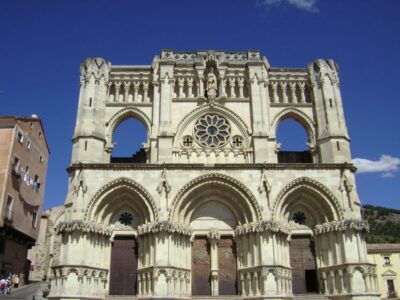
Cuenca and the Enchanted City Full Day Tour from Madrid
Read our review →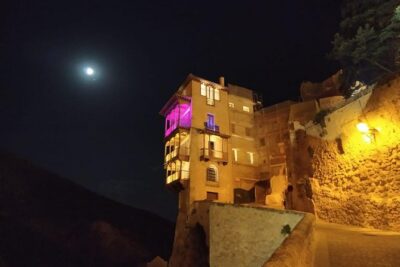
Cuenca: Nighttime Highlights Walking Tour in Spanish
Read our review →Browse the lists this tour appears in