
Reviewed · 2-HOUR EXPERIENCES
Tour Madrid in 2 hours! Electric Tuk – Fast, Fun, and Exclusive
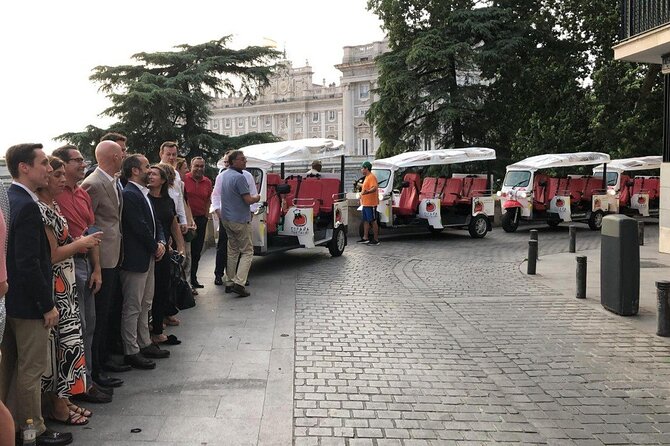
Madrid can feel huge on Day 1, so this 2-hour electric tuk circuit is interesting because it helps you spot the city’s main pieces fast. I especially like the private group setup, which keeps the pace practical and your questions on topic. And I like that the route mixes royal Madrid, classic plazas, and modern landmarks, so you leave with a real sense of how neighborhoods connect.
One possible drawback is timing. Because it is a multi-stop loop, you’ll want to plan for short stops and photo moments, and you should expect that pickup or arrival points can be a little chaotic if your timing or GPS is off.
Key highlights you will actually feel
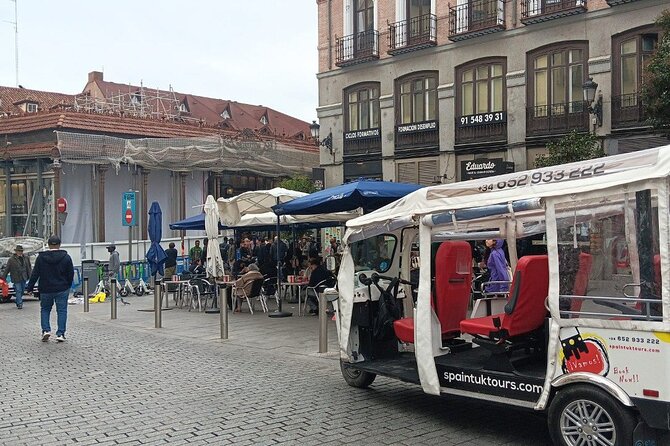
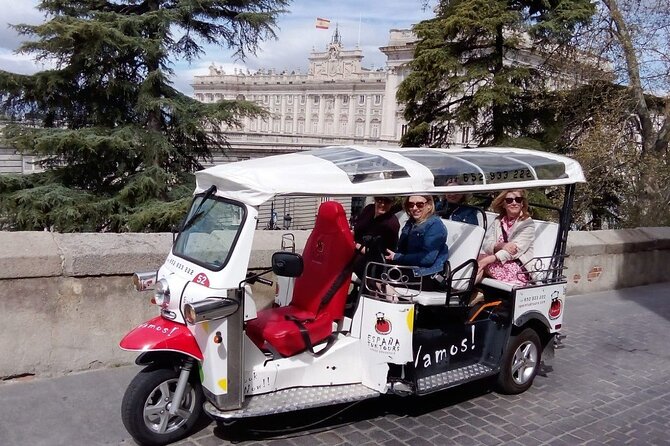
- Private and small-group feel: Up to 4 people per group, so you are not stuck with a crowd.
- Electric tuk efficiency: You cover a lot of Madrid landmarks in about 2 hours.
- Photo help built in: A driver and guides have been praised for their photo instincts and clear stopping points.
- Royal plus old town mix: Royal Palace area, Plaza Mayor, and Mercado San Miguel sit next to each other on the same ride.
- Art-area storytelling: You get the names and context behind major European painting treasures and nearby churches.
- Big landmarks included: You go from Puerta de Alcalá to Las Ventas and then toward Bernabéu and Cibeles.
A fast electric tuk route that helps you read Madrid
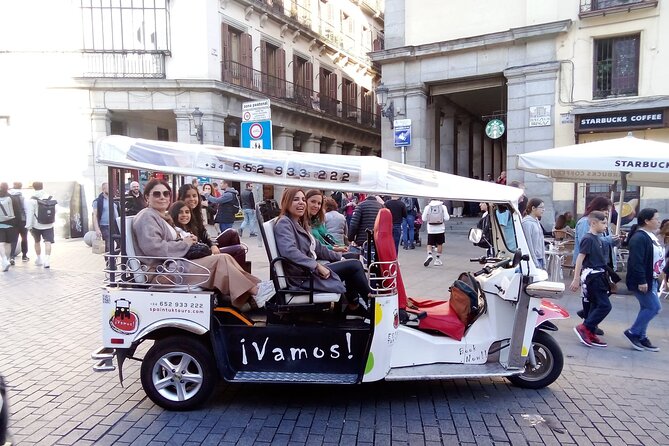
If you want Madrid to make sense quickly, the smart move is to start with a route that links neighborhoods. That is what this tour does. You do not just see one pocket of the city, you get a nonstop overview that ties together royal sites, old town squares, and modern Madrid streets.
The electric tuk matters here. It keeps the vibe fun while cutting down on walking between far-flung points. You still get outside views, plus enough time at each stop to orient yourself. This is the kind of outing that helps you decide what to return to later, on foot, at a slower pace.
More of Madrid worth an open tab:
- Madrid: Tour Bernabéu Entry Ticket
★ 4.5 · 21,573 reviews - Madrid: Prado Museum Entry Ticket
★ 4.6 · 17,509 reviews - Madrid: “Emociones” Live Flamenco Performance
★ 4.8 · 12,866 reviews
Plaza de Santa Ana and the Cortes-to-Old-Centro vibe check
You begin at Pl. de la Lealtad in the Retiro area, then head toward the Centro core. One of your first moments is Plaza de Santa Ana, in the Cortes neighborhood. It is an open space that dates back to 1810, and it has changed over time with shifting urban plans. In plain terms, it is a good first stop because you can feel the neighborhood’s energy and understand where you are in central Madrid.
This area also sets expectations for the tour’s style. The stops are short, often around five to ten minutes. That means you should treat these as “look, frame your photos, listen, and move” moments. If you love details, you will do best when you arrive ready to focus for quick intervals.
Royal Palace area: Almudena Cathedral Museum and Sabatini Gardens
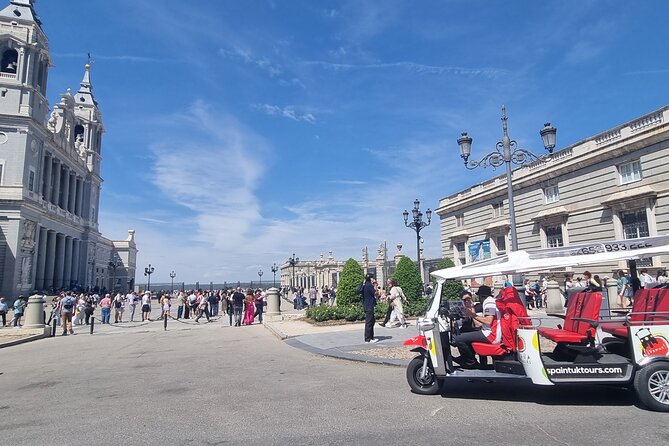
Next you swing into the Royal Palace zone. The Royal Palace of Madrid (Palacio de Oriente) is one of those places that instantly signals power and pageantry. Construction began in 1738 and lasted about seventeen years. Later, Carlos III made it his regular home in 1764, which is why you’ll hear a lot of royal-life context even though today it is used for receptions, ceremonies, and official events.
Important practical note: the palace admission fee is not included. So what you will get is mostly exterior viewing and context, unless you decide to buy tickets separately on your own.
Right nearby is the Museo de la Catedral de la Almudena. This cathedral is a major religious landmark in Madrid, consecrated on June 15, 1993 by Pope John Paul II. One of the neat “this is Madrid, but also not like anywhere else” facts you will hear is that it became the first consecrated cathedral outside Rome. The museum portion is built around story objects, with dozens of items spread across multiple rooms, including mosaics and episcopal shields.
Between those sights, you get Jardines de Sabatini, a green pause in front of the palace’s north facade. At 2.66 hectares, it is large enough to reset your brain after dense stone architecture. Even if you do not spend long here, it helps you understand the layout of this royal complex.
Debod Temple to Plaza Mayor: from ancient Egypt to Madrid’s classic core
Then comes one of the most surprising contrasts on the route: Debod Temple. This ancient Egyptian structure now lives in Madrid, located west of Plaza de España, next to the Paseo del Pintor Rosales on a hill where the Mountain Barracks once stood. That relocation alone is a story you can feel in the moment. Madrid is not just one era, it is layers.
From there, the tour lands in the heart of old Madrid at Plaza Mayor. This is the kind of plaza that feels like the city’s living room. It sits in the old town area of Madrid de los Austrias and works as a natural starting point for a deeper wander. The plaza began in the footprint of the old Plaza del Arrabal, which hosted a popular market at the end of the 15th century, right around the time Philip II moved the court to Madrid. Later, in 1617, architect Juan Gómez de Mora was commissioned to create uniformity in the buildings around the square.
Plaza Mayor is also where you learn why Madrid squares matter. They have hosted celebrations, bullfights, beatifications, coronations, and other faith-related events. In other words, this is not just pretty architecture. It was built for civic life.
A short hop brings you to Mercado San Miguel, a covered market dating to around 1916. This is the spot for snacks and local food browsing in an easy, social atmosphere. It is also a good place to practice your own “what do I actually want to eat” decision before you commit to a sit-down meal later.
Still in Madrid, a different sort of afternoon:
- Madrid: Panoramic Route City Tour
★ 4.1 · 12,259 reviews - Madrid: Live Flamenco Show with Food and Drinks Options
★ 4.5 · 9,901 reviews - Avila & Segovia Tour with Tickets to Monuments from Madrid
★ 5.0 · 9,762 reviews - Three Cities in One Day: Segovia, Avila and Toledo from Madrid
★ 5.0 · 8,402 reviews
Writers’ lanes, church landmarks, and Plaza de las Cortes details you can spot fast
The route continues through areas tied to Spain’s literary giants. You stop near the former residence of Miguel de Cervantes, author of Don Quijote. The site offers guided tours, so even if you are not going inside during your brief stop, you are at least placed in the right context for when you might return.
You also encounter the House of Lope de Vega, built in the 16th century. It is one of those “famous author homes” that helps you understand why Madrid feels literary even beyond books. Lope de Vega acquired the property in 1610 and lived there until his death in 1635. Again, this is likely a quick visual and listen-and-learn moment rather than a long museum visit, but it gives you hooks for a future deeper dive.
Then you head to Plaza de las Cortes, anchored by the Palace of the Spanish Courts. This building sits on the site of the old convent of the Holy Spirit, which served as the seat of Congress between 1834 and 1841. Look up at the main facade: you get a neoclassical portico with six Corinthian columns and a triangular pediment decorated with reliefs. The lions flanking the entrance are a striking detail, cast using iron from cannons captured during the war in Africa. That is the kind of fact you will remember because it explains the weird, specific symbolism.
You will also hear how the building is organized inside, including the well-known session room and the library or conference room often called the lost steps room. Expect mostly exterior orientation here, but the architectural details are clear enough to notice from outside.
Neptune Fountain, a major European painting stop, and San Jerónimo el Real
Midway through, you get Neptune Fountain at the center of the roundabout in Plaza de Cánovas del Castillo. This neoclassical fountain was proposed in 1777, with construction starting in 1782 and finishing in 1786. It is a great “pause and frame the city” stop because it gives you a focal point in a traffic circle, and it breaks the rhythm between royal and modern sections.
From there, the tour heads into an art area where the storytelling really helps. You will stop by a major European painting museum with an emphasis on 16th to 19th century masters. The artists highlighted include Velázquez, El Greco, Goya, Titian, Rubens, and El Bosco, plus other major names mentioned in the same context. Even without going deep into galleries during a two-hour ride, you will come away with a clearer sense of what this museum is known for. That matters because it helps you choose what to prioritize if you later buy a ticket to see specific works.
Next is San Jerónimo el Real, popularly called Los Jerónimos, near the Prado Museum area. This parish church is late Gothic with Renaissance influences from the early 16th century. It has been remodeled and restored many times, so you will see an evolving structure rather than a single frozen moment in time. You will also learn its royal connections, including that it was built by order of the Catholic Monarchs and later used for spiritual retreats by monarchs. Royal investitures happened here for centuries, and the wedding of Alfonso XIII took place here as well. A big visual detail to remember is the great stairway leading to the entrance, built in 1906.
Puerta de Alcalá, Las Ventas, and how Salamanca feels different from the center
Now the tour swings toward monuments that make Madrid feel grand. Puerta de Alcalá is a prime example. It was built by mandate of Carlos III to replace a previous 16th century door and was inaugurated in 1778. It was designed by Francesco Sabatini, and it is a granite neoclassical triumphal arch. The fun context you will hear is that it is described as the first in Europe after the fall of the Roman Empire, and it is often mentioned as a precursor to arches like the Arc de Triomphe in Paris and the Brandenburg Gate in Berlin.
Notice the five openings compared with the usual three. The decorations also change by facade: the inner side is easier for visitors first entering to see, while the exterior is more decorative and what people walking into Madrid would notice.
Then you pass by Las Ventas bullring, described as the biggest bullfighting arena in Spain. It has 23,798 spectators and sits among the largest bullrings worldwide. Even if you are not attending an event, it is one of the most distinctive architectural statements for Madrid’s cultural identity.
After that, you enter Barrio de Salamanca, a more upscale mood with major streets such as Velázquez, Ortega y Gasset, and Serrano. This change of neighborhood is one of the best parts of a quick tour, because you get a built-in comparison: old stone and royal plazas versus wide avenues and refined streets.
Bernabéu and the modern Madrid lineup along Paseo de la Castellana
The tour heads toward Santiago Bernabéu Stadium. It opened on December 14, 1947, and its current capacity is listed as 81,044. Even if football is not your thing, the stadium stop is a useful Madrid lesson. It shows how the city builds big modern icons near older landmarks and still keeps the cultural thread.
From there, you ride through the financial district along Paseo de la Castellana. The point is not just to see office towers. It is to understand how quickly Madrid shifts gears once you move out of historic cores. This section is also where you get a visual break before the tour ends with classic downtown icons.
Plaza de Colón, Cibeles, and the city’s loudest landmarks in the last stretch
The final portion leans into big, famous moments. At Plaza de Colón, you will see the Columbus monument. It is a white marble neo-Gothic sculpture, 17 meters tall, built in 1885 by Jerónimo Suñol for the wedding celebration between Alfonso XII and María de las Mercedes de Orleans. Even if you only do a quick look, the monument’s scale makes it a mental bookmark for the rest of your trip.
Nearby are the Gardens of Discovery, opened in 1970, with sculptures that include a monument dedicated to the discovery of America. Under the plaza is the Cultural Center of Villa Fernán Gómez, which is handy to know if you plan evenings away from museums.
Then you pass by the National Library of Spain (BNE). It is described as an autonomous body responsible for Spain’s bibliographic heritage, holding around thirty million publications produced since the beginning of the 18th century, including books, magazines, maps, prints, drawings, scores, and brochures. For a two-hour tour, you may not spend time inside, but you do get the scale of what you are standing near.
Next is Cibeles Fountain, one of Madrid’s signature photo spots. It is surrounded by major buildings including the Palacio de Buenavista, Palacio de Linares, Palacio de Comunicaciones, and the Bank of Spain. The fountain features the Roman goddess Cibeles on a chariot pulled by lions. The goddess and lions are carved in marble, and the rest is in stone. The goddess work is attributed to Francisco Gutiérrez, and the lions to French sculptor Roberto Michel. It is also an icon for Real Madrid fans, especially for title celebrations.
The tour then continues past the grand national bank building area and along Gran Vía, Madrid’s famous boulevard that runs from Calle de Alcalá to Plaza de España. Gran Vía is described as a major milestone from the early 20th century, shaped by commercial, tourist, and leisure life. In a short ride, it is the kind of street that makes you feel how Madrid became modern.
Guides, drivers, and what to expect from the two-hour pace
This is where the experience can really shine. In the feedback you provided, guides and drivers get high marks for being clear, helpful, and good with photos. One driver, Tadeo, was specifically mentioned with praise for the tour experience and photography. Another highlight: an Angel guide was described as friendly, informative, and cooperative for pictures, and there is also mention of local cuisine questions being welcomed.
That matters because the tour is short. If your guide is strong, you can turn a few minutes at each stop into real learning. If your guide is weak, it becomes just a fast ride with some photos. Based on what you shared, the quality has been a key part of the value.
One more practical note from your info: if you have trouble finding the meeting point due to GPS confusion, the team has shown they can be flexible, even offering help such as a coffee while you get sorted out. Still, I recommend arriving early and using the exact meeting address to avoid last-minute stress.
Price and value for a Madrid sight-seeing sprint
At $215.07 per group (up to 4), the cost works out to roughly $54 per person if you split it evenly. That is the kind of pricing that can make sense when you compare it to paying separately for a guided tour, especially in a city where top sites are spread out.
What you are buying is convenience plus context. You get a private setup, an efficient electric tuk ride, and quick guided stops at major landmarks. You also get a built-in ordering of sights: royal Madrid first, old town anchors next, then the more modern monuments and wide avenues. That can save you time choosing where to go on your own later.
Just be honest about expectations. Since it is about covering lots of highlights in a short window, it is not a ticket into every building. The Royal Palace admission fee is not included, and the tour is clearly designed for exterior and short stop viewing in most places.
Should you book this Madrid electric tuk tour
Book it if you want a first-day or reset-day overview. You will get major contrasts, from ancient Egypt at Debod Temple to classic civic life at Plaza Mayor, and then modern icons like Bernabéu and the Cibeles photo moment. You will also benefit if you care about photography and like guides who can help you frame shots and understand what you are looking at.
Skip it, or plan a different approach, if you want a slow, sit-down museum day. This tour is built for momentum, so if your priority is lingering inside churches, palaces, or galleries, you will likely do better pairing this with separate ticketed time on another day.
If you do book, do two things that make the experience smoother: confirm the language you want is supported for your group, and arrive a little early to protect the start time. Then relax, let the route do its job, and use the stops to pick your next day priorities.
Recently reviewed around Madrid
- Madrid: Treasure Hunt Experience★ 5.0 · 4 reviews
- Madrid Spanish Omelet Cooking Class and Bottomless Wine brunch★ 5.0 · 50 reviews
- Avila and Segovia private day trip with hotel pick up from Madrid★ 5.0 · 68 reviews
- Prado Museum Tour with ticket, small group & expert guide★ 5.0 · 6 reviews
- Bernabeu Stadium Private Guided Tour★ 3.5 · 4 reviews
- Spanish Group Course in Madrid, Spain: 20 Lessons★ 5.0 · 11 reviews
- Self-Guided Audio Tour – Cervantes Literary Experience in Madrid★ 4.0 · 6 reviews
- Madrid Bike Tour with Churros and Wine, Ham, and Cheese Upgrade★ 5.0 · 8 reviews
2-Hour Experiences, compared.
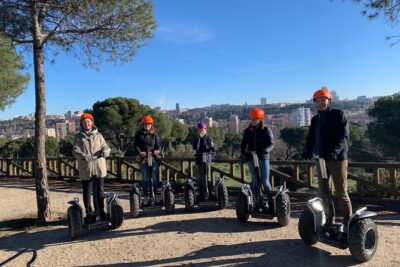
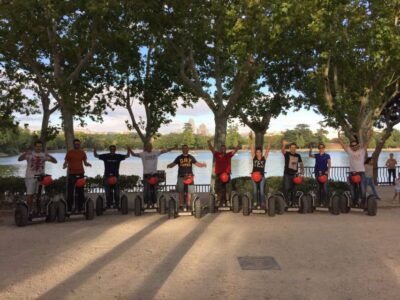
2-Hour Private Off-Road Segway Tour of Casa de Campo
Read our review →Browse the lists this tour appears in