
Reviewed · WALKING TOURS
Highlights of Madrid – Small Group Walking Tour
Madrid works best on foot, and this small-group walk is a smart way to get your bearings fast. You start in the thick of Old Madrid energy and finish at an ancient Egyptian stop that feels totally unexpected in the middle of a modern city.
I especially like the tight 2-hour route that keeps things moving without turning into a sprint, and the expert local guide who explains what you are looking at in plain language. I also love that it is priced at $24 with free admission at every listed stop, so you can budget in one clean number.
One thing to consider is the direction of the day: the walk trends west toward Moncloa, so you will end at Temple of Debod and you may want a simple plan for getting back into the center afterward.
Key highlights to know before you go

- Small group size (max 25) keeps the pace human and the Q and A realistic.
- A leisurely 2-mile walk for a very sight-dense route through central Madrid.
- Free admission at each listed stop, so you avoid surprise ticket costs.
- Puerta del Sol to Temple of Debod creates a great morning storyline.
- English tour with confirmation at booking and a mobile ticket.
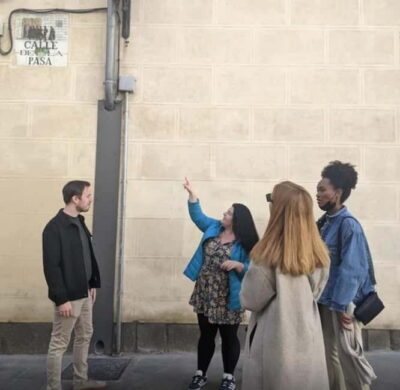
- Guides like Fatima are singled out for being very informative and full of Madrid details.
Where the walk starts: Puerta del Sol and the city’s heartbeat
Puerta del Sol is Madrid’s central meeting point, not just on a map, but in real life. This square is where locals and visitors naturally funnel together, and it helps that it contains a famous landmark right in the middle of the action, the Statue of the Bear and the Strawberry Tree. It is the kind of spot that looks simple at first, but once someone explains it, you start noticing layers.
From here you also get a historic marker connected to the 16th-century Spanish Road. That is useful because Madrid’s streets can feel like a grid that grew over time, not a designed plan. A quick explanation at the start helps you read the city better for the rest of the morning.
This is also a good place to settle in with your walking shoes and your attitude. You are not just doing photos, you are learning the logic of the center, and that makes the next squares feel connected instead of random.
More walking tours in Madrid:
- Toledo Tour & Vineyard Walk with Wine Tasting from Madrid
★ 5.0 · 2,546 reviews - Madrid Walking Tour from Puerta del Sol to Retiro Park
★ 5.0 · 2,285 reviews - Madrid Old Town & Royal Palace Walking Tour Skip the Line Ticket
★ 4.5 · 1,829 reviews
Plaza Mayor: legends, architecture, and the rhythm of Old Madrid
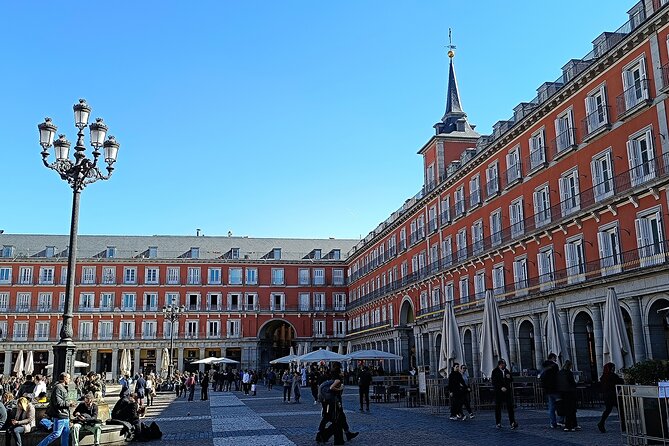
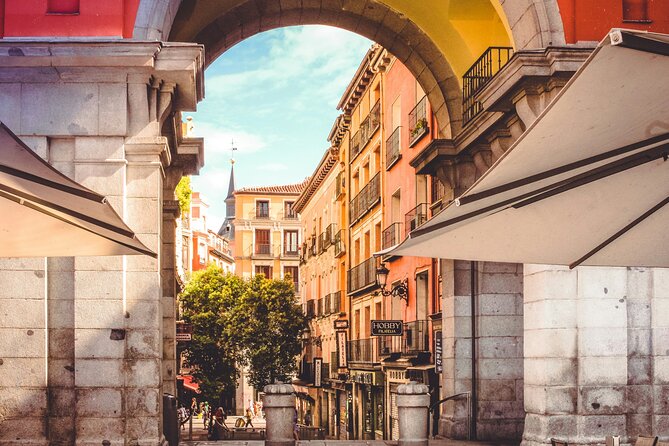
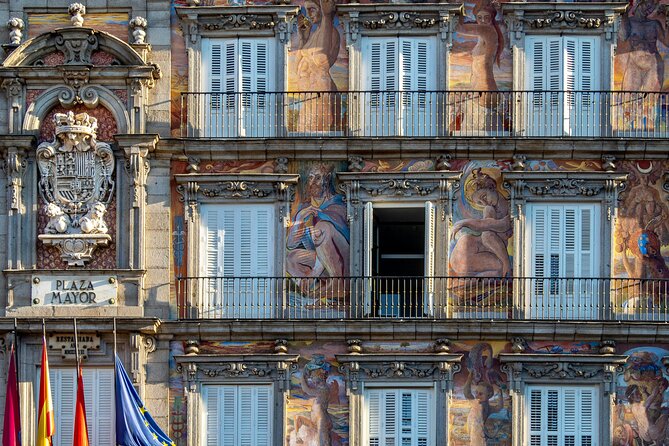
A short walk brings you to Plaza Mayor, the classic core of Old Madrid. It is a big stage for architecture, with a lot of classic details that can be hard to appreciate if you are rushing. In this tour, you get just enough time to look up, slow down, and understand why people love to linger here.
The best part is the stories tied to the place. Legends are not filler. They help you connect the buildings to real human moments, like who gathered here, what was happening, and why this square stayed important even as Madrid modernized around it. Once someone gives you that frame, you will notice the way the square pulls people in from every side.
Plaza Mayor also gives you a quick reality check on timing. If you arrive with low energy, this kind of stop can feel like a chore. If you arrive curious, it feels like a break that still moves the tour forward.
Mercado de San Miguel: cast-iron details and how to use your time
Then comes Mercado de San Miguel, one of Madrid’s best-known food markets. The key detail to notice is the cast-iron architecture, because it gives the market a character that is almost like a small indoor landmark. Even if you do not plan to buy much, it is worth pausing because the structure is a big part of the experience.
A short stop like this is perfect if you use it well. Look at the overall shape of the space, spot the lines and patterns created by the ironwork, and scan what is being sold. You will get the vibe of a market that attracts crowds, yes, but also one that still reads as a designed, old-school place to eat.
The tour gives you time, but it is not long enough to turn into a full meal plan. If you want to sample something, I would treat this as a quick tasting window rather than a full sit-down plan. Otherwise, you will feel rushed and miss the architecture part.
Plaza de la Villa: Casa de los Lujanes and Madrid across centuries
Plaza de la Villa is where the city starts to feel older in a quieter way. It is one of Madrid’s oldest squares, and that age shows in the atmosphere. The standout here is Casa de los Lujanes, described as the oldest civil building in Madrid.
What I like about this stop is the way the tour frames the buildings as time markers. You can see three different buildings built in three centuries, which helps you understand that Madrid did not grow in one uniform wave. Different eras left their fingerprints, and the square becomes a simple lesson in how cities layer time.
This is also a great moment for photos that are not just postcards. Try taking a photo from an angle that shows the mix of structures. You will get a clearer sense of the “many-Madrids” feeling than you will with a straight-on shot.
Still in Madrid, a different sort of afternoon:
- Madrid: Tour Bernabéu Entry Ticket
★ 4.5 · 21,573 reviews - Madrid: Prado Museum Entry Ticket
★ 4.6 · 17,509 reviews - Madrid: “Emociones” Live Flamenco Performance
★ 4.8 · 12,866 reviews - Madrid: Panoramic Route City Tour
★ 4.1 · 12,259 reviews
Royal Palace area: big sights without the hassle
The route includes the Royal Palace of Madrid, and even from outside, the scale hits you. It is the official residence of the Spanish royal family in the city, and it is also noted as the largest royal palace in Western Europe. That is one of those facts that can sound like trivia, but it changes how you view the space. The palace is not just pretty, it is meant to signal power through size.
The tour also brings royal stories into the mix. That matters because palace architecture can feel like a museum display unless someone connects it to real life, politics, and daily court drama. With the right explanations, the palace becomes a social stage rather than a wall of stone.
Right after that, you face the Teatro Real, the Royal Theater. It is one of Europe’s most prestigious opera houses, built in the 19th century and positioned to face the palace in Plaza de Oriente. This is a rare pair: palace authority in one direction, cultural ceremony in the other. If you love opera or just like the idea of art with real traditions, this stop delivers.
Plaza de España and Cervantes: a literature stop that actually works
Plaza de España is often treated as a quick transfer point, but this walk gives it a reason to matter. The focal point is the monument to Miguel de Cervantes, the author of Don Quixote. It is a literary marker in a public square, which is not always how people expect to see famous authors honored.
What you take away here is the connection between Spain’s cultural identity and its public spaces. Madrid is a city where literature and politics show up in everyday views. When your guide ties the monument to Spanish literature history, the square stops feeling like a generic monument plaza and starts acting like a cultural map.
You get enough time to stand in front of the monument, look around, and get your bearings for the final leg. This is also a good point to decide how much energy you want to save for the ending, because the last two stops shift the mood.
Temple of Debod: why this ancient Egyptian temple feels so surprising
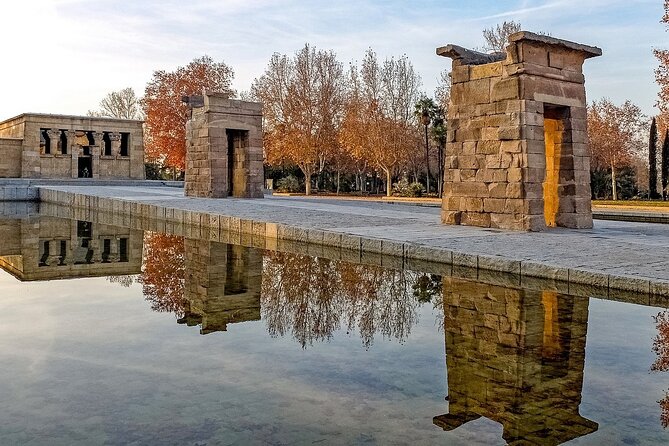
Now for the plot twist. Temple of Debod is an authentic ancient Egyptian temple, dating back to 200 BC. In Madrid, that simple fact is already mind-bending. The tour also explains how it arrived in Madrid and why, which turns it from a cool photo stop into a story about exchange and preservation.
This is the kind of ending that makes the whole morning feel more memorable. You do not end with another Spanish square. You end with an ancient structure that anchors Madrid to a much wider world.
It also helps that the tour ends here. That creates a clear finish line, which is great for planning the rest of your day. Just remember this is at the end of the route, so plan transport accordingly if you are heading back toward the center.
Catedral de Sta Maria la Real de la Almudena: the patroness angle and architectural stops
The walk also includes Catedral de Sta Maria la Real de la Almudena, dedicated to the Virgin of Almaden, listed as patroness of the city. Cathedral visits can go one of two ways: either you rush through and miss the meaning, or you stop and feel overwhelmed by how much there is to see. In this tour, you get the right middle ground, a focused look at the architecture plus the religious and local context.
Understanding the dedication matters because it gives you a lens for what you are seeing. You might not catch every detail on your own, but you will recognize why certain features matter when you know the story behind them.
This stop also balances the day. After the palace and theater grandeur, the cathedral brings you back to something grounded in daily devotion and civic identity. Even if you do not consider yourself religious, it is easier to appreciate the building when it is explained as a living piece of Madrid, not just a landmark.
How long it really takes, and what that pace means for your day
The tour runs about 2 hours and covers roughly 2 miles at a leisurely pace. That combination is the whole point. You get a concentrated route through major sights without draining yourself like a full-day hike.
You also get a schedule that feels realistic: most stops are brief, and the total time adds up without long detours. That matters if you have limited time in Madrid or if you want a morning activity that does not steal your whole afternoon.
Another practical bonus is the group limit of 25. It is large enough that you will meet other people, small enough that the guide can keep control and keep explanations moving.
Start time is 9:00 am, which is a great choice in summer because the light tends to be nicer earlier, and the streets are often less chaotic at first. If your day is packed, this kind of morning walk helps you place later destinations in context.
Value check: what $24 covers, and why it feels fair
At $24 per person for about 2 hours, this tour is good value if your goal is getting oriented quickly. You are not paying for a big museum ticket or a complicated transportation plan. Instead, you are paying for someone to connect the dots between major public spaces.
You also get free admission at each listed stop, which keeps the cost straightforward. That is huge for travelers who hate the feeling of paying multiple small fees throughout the day.
A detail that reinforces the value is the booking pattern. On average, this type of tour is booked around 27 days in advance. That usually means the dates move, and it often signals that people find it useful, not just pleasant.
If you care about a guided walk that helps you understand what you see without turning it into a lecture, this price makes sense.
English guide, mobile ticket, and the real-world comfort level
The tour is offered in English, and you receive a mobile ticket. For many people, that is the practical win: less paperwork, less confusion at the meeting point, more time spent enjoying the route.
The meeting point is Heladería PalazzoPrta del Sol, 11, Centro, 28013 Madrid. It is a very readable starting area because it anchors you at the heart of Madrid, not at some hard-to-find side street.
At the end, you finish at Temple of Debod. That is a different location than the classic city-center loop, so I recommend thinking about how you will move after the tour. If you plan to sightsee further, map your next stop before you start walking.
Service animals are allowed, and the tour states that most people can participate. The pace is leisurely, and the total distance is modest, which makes it a solid option for a first-time Madrid day.
Who this walk suits best, and who might prefer something else
This is ideal for first-time visitors who want to learn the city’s story quickly, or for anyone with a morning window and a wish to see major highlights without overplanning. It is also a good fit if you like context, because the guide connects squares, monuments, and buildings to stories you can remember later.
If you are the type who wants long sits, deep museum time, or inside-the-building visits, this may feel too fast. The stops are designed to be look-and-learn, not all-day exploration. You might prefer a longer, more specialized tour if you want to spend more time inside specific sites.
That said, for most people, the format works because it gives you a strong framework for the rest of your Madrid trip.
Should you book this Madrid walking tour?
I would book it if you want a high-signal overview of central Madrid in a short amount of time. The route is logical, the mix of royal, cultural, and unexpected ancient Egyptian content creates variety, and the free stop admissions help keep costs simple.
I would hold off if your schedule only allows for a very specific neighborhood, because the walk ends at Temple of Debod. Also, if you hate walking or need very long breaks, the brief stops might feel a bit tight.
With a 4.9 rating and a strong recommendation rate, plus clear praise for guides like Fatima for being informative and full of Madrid knowledge, this is the kind of guided walk that tends to leave you feeling oriented, not overwhelmed.
FAQ
How long is the Madrid walking tour?
It lasts about 2 hours.
How far do we walk during the tour?
The tour covers about 2 miles at a leisurely pace.
Where do we meet, and where does the tour end?
You start at Heladería PalazzoPrta del Sol, 11, Centro, 28013 Madrid, Spain. The tour ends at Temple of Debod, C. de Ferraz, 1, Moncloa – Aravaca, 28008 Madrid, Spain.
What time does the tour start?
The start time is 9:00 am.
Is the tour offered in English, and do I get a mobile ticket?
Yes, it is offered in English, and it includes a mobile ticket. Confirmation is received at booking.
Are there extra admission costs at the stops, and is cancellation refundable?
All listed stops are marked as admission ticket free, so there are no extra entry fees noted for these parts of the route. Free cancellation is available, and you can cancel up to 24 hours in advance for a full refund.
Recently reviewed around Madrid
- Madrid: Treasure Hunt Experience★ 5.0 · 4 reviews
- Madrid Spanish Omelet Cooking Class and Bottomless Wine brunch★ 5.0 · 50 reviews
- Avila and Segovia private day trip with hotel pick up from Madrid★ 5.0 · 68 reviews
- Prado Museum Tour with ticket, small group & expert guide★ 5.0 · 6 reviews
- Bernabeu Stadium Private Guided Tour★ 3.5 · 4 reviews
- Spanish Group Course in Madrid, Spain: 20 Lessons★ 5.0 · 11 reviews
- Self-Guided Audio Tour – Cervantes Literary Experience in Madrid★ 4.0 · 6 reviews
- Madrid Bike Tour with Churros and Wine, Ham, and Cheese Upgrade★ 5.0 · 8 reviews
Walking Tours, compared.

Toledo Tour & Vineyard Walk with Wine Tasting from Madrid
Read our review →
Madrid Walking Tour from Puerta del Sol to Retiro Park
Read our review →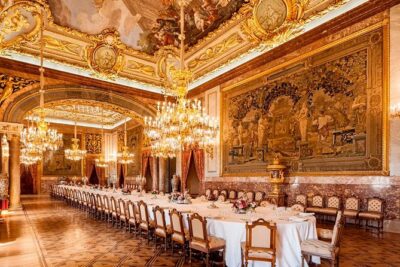
Madrid Old Town & Royal Palace Walking Tour Skip the Line Ticket
Read our review →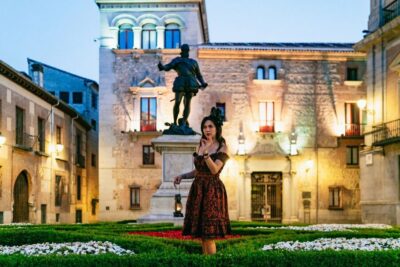
Spanish Inquisition and Legends Evening Walking Tour
Read our review →
6-Hour Day Trip to Toledo with Guided Walking Tour
Read our review →
Browse the lists this tour appears in