
Reviewed · MADRID TUK-TUK TOURS
Madrid Welcome Tour with Local Guide in Eco Tuk Tuk Private
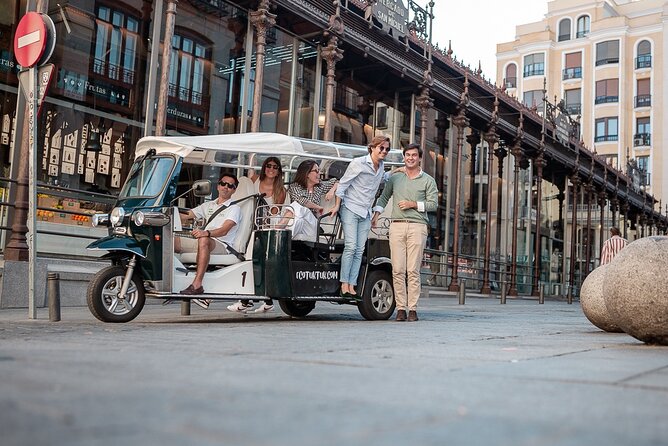
A Madrid welcome tour in a 100% electric eco tuk tuk is interesting because it mixes big sights with low effort. You glide past landmarks that would take hours to reach on foot, then get a quick, human explanation at each stop.
I especially like two things. First, the pre-selected photo stops mean you are not guessing where to pull over for a good view. Second, the tour is designed to start smoothly, so you can spend your time learning rather than waiting.
One thing to plan for: this is an overview, not a slow museum day. It can feel fast, and the meeting spot is in an underground station area near the Royal Palace, which takes a moment to find.
Key points
- Electric eco tuk tuk transport keeps the ride comfortable and modern through central Madrid.
- No queues or waiting helps the guide spend more time on stories and practical pointers.
- Blankets and protective layers make winter and windy days genuinely doable.
- Major highlights in one route, from Atocha Station to Almudena Cathedral and Royal Palace views.
- Photo stops are arranged so you get classic angles without lots of rerouting.
Eco Tuk Tuk Welcome Tour: Why This Madrid Loop Works
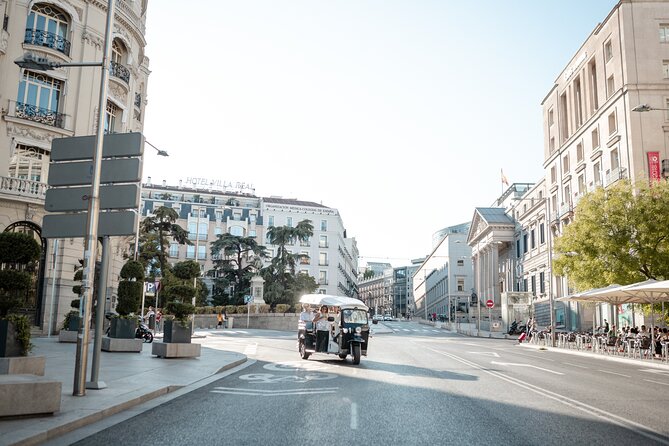
If you want a first look at Madrid that actually helps you plan your trip, this tour fits the bill. You are not stuck in one neighborhood. Instead, you hop across the city center in a way that lets you see how Madrid is laid out: royal and religious monuments near each other, major art within a quick stretch, then classic city squares and viewpoints.
The eco tuk tuk format also changes the vibe. Buses can feel rushed or generic. Here, the pace is guided by your route and the stops you make. You get a series of “stop, look, learn” moments, which is ideal when you do not have a full day to wander or when you are trying to avoid sore feet on day one.
For the price, you are really paying for two things: convenience and guided context. At about $28.66 per person, you are not just buying a ride. You are buying a shortcut to understanding what matters and where to return later, on your own time and at a slower pace.
More tuk-tuk tours in Madrid:
- Madrid: Private City Tour by Eco Tuk Tuk
★ 4.9 · 2,876 reviews - Madrid Historical Tour with Local Guide in Eco Tuk Tuk Private
★ 5.0 · 876 reviews - Madrid Express Tour with Local Guide in Eco Tuk Tuk Private
★ 5.0 · 413 reviews
Where You Start Near the Royal Palace Underground Station
The meeting point is on C. de Bailén, 4, Centro, but the practical reality is that you head to the underground bus station area at Plaza de Oriente, right by the Royal Palace area. The instructions point you toward Puerta del Príncipe, and it is worth taking that guidance seriously, because the street numbering can be confusing.
Good news: you do not have to figure it out solo. There is a phone and WhatsApp contact listed, and the pickup is near public transportation. For anyone with mobility concerns, there is also help with accessing the meeting point via elevator if you contact them ahead of time.
When I see tours like this work well, it is often because people arrive a little early and already know what they are looking for. If you are starting your first Madrid day, do yourself a favor and arrive early enough to get calm, not rushed.
Price, Time, and What You Really Get for About $28.66
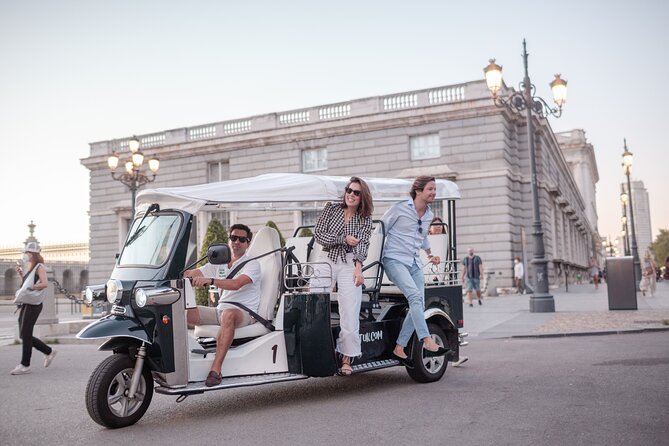
This is sold as a private experience for your group, with the vehicle reserved just for you. Tuk-tuks are sized so the legal maximum is 4 passengers per tuk-tuk, and the price is set based on how many tuk-tuks your group needs.
That matters because it changes how you experience the tour. You are not negotiating with strangers for seating, timing, or conversation. The driver-guide can also tailor small route choices to how your group moves, how long you linger for photos, and how quickly you want to hear the next set of facts.
Duration is listed as 1 to 4 hours, and the idea is that you can match it to your schedule. If you only have a short window, the tour still gives you strong bearings. If you have more time, you get extra room to absorb the city.
One caution: the tour itinerary may change due to closed streets or demonstrations. That is normal in a major capital, and it is part of travel. What you should know is that the stops for photographs are prearranged, and the tour cannot be modified to add new ones on the spot.
Stop-by-Stop: Covered Market, Basilica of Our Lady of the Angels, and Atocha

The route is built around classic central Madrid, and the early stops help set the tone: food, faith, rail, and civic buildings, all within reach of one ride.
Still in Madrid, a different sort of afternoon:
- Madrid: Tour Bernabéu Entry Ticket
★ 4.5 · 21,573 reviews - Madrid: Prado Museum Entry Ticket
★ 4.6 · 17,509 reviews - Madrid: “Emociones” Live Flamenco Performance
★ 4.8 · 12,866 reviews - Madrid: Panoramic Route City Tour
★ 4.1 · 12,259 reviews
Mercado area from around 1916
You start at a covered market dating to the early 1900s era. This type of stop is not just for sightseeing, it helps you read the city. Markets like this tell you how locals eat, shop, and socialize, and they often keep a calmer rhythm than the big tourist squares nearby. You get the atmosphere of local food, delis, and events in a setting that feels elegant rather than chaotic.
If you are planning where to eat later, pay attention here. Even if you do not buy anything, this stop can steer you toward neighborhoods and food styles you will recognize when you walk again.
Basilica area: San Francisco the Great (Our Lady of the Angels)
Next you head toward the Basilica of San Francisco the Great, officially known as the Basilica of Our Lady of the Angels. The building sits in the Palace district within the historic center, so it fits the royal and monumental theme of the tour.
A useful way to look at this stop: think of the basilica as part architecture, part cultural landmark. Madrid’s religious buildings are not only places of worship, they are also major reference points in the city’s layout.
Atocha railway station
Then comes Atocha, one of Madrid’s most important transport hubs. The tour frames it as a busy passenger station and a major node in Europe. That matters because it is a real-life Madrid landmark, not just a pretty postcard. If you are visiting other cities, this is the station you will most likely recognize later.
Even if you do not connect trains during your trip, seeing Atocha helps you understand how Madrid moves. It is a good reminder that a city tour should include the practical places, not only monuments.
Congress and the Spanish Courts, Plus the Fountains of Cibeles and Neptune
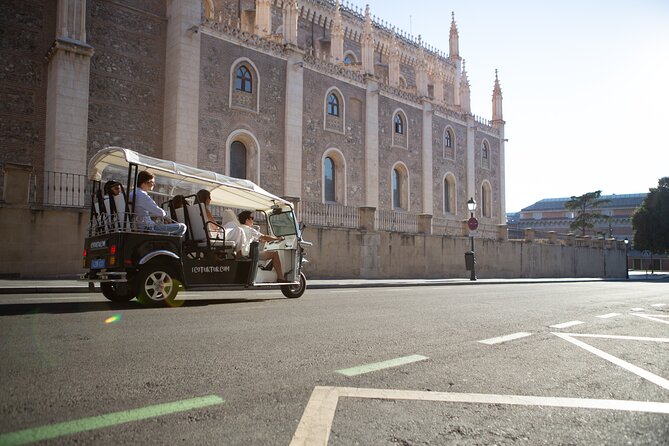
After Atocha, the tour leans into civic Madrid. You see how the city’s power structures and public celebrations are shaped into the skyline.
Palace of the Spanish Courts
The Palace of the Spanish Courts is built on the former convent of the Holy Spirit, which served as the seat of Congress in the 19th century. That kind of layered site makes the building feel more than just neoclassical decoration.
On the main facade, there is a staircase leading to the neoclassical portico with six Corinthian columns and a triangular pediment. The details are part of the story, even if you do not enter. The lions flanking the entrance are noted as works connected to sculpting using iron from cannons captured in the African war, which is the sort of detail that makes a facade memorable.
Inside, the standout room is the Session Hall, plus other notable rooms like the library and what is known as the hall of the lost steps. You may not get deep access on a short tour, but the outside look plus the building context is enough to help you recognize what you are seeing later from the right angle.
Cibeles and Neptune: where sports fandom meets city design
One of the most iconic photo moments is the space around the fountains for Cibeles and Neptune. The tour explains a key idea: fans of Atletico celebrate near the square of the sea god, while Real Madrid supporters celebrate at Cibeles.
It also adds design history. In Ventura Rodríguez’s original plan, both fountains were intended to face each other along the Paseo del Prado. Later restructuring and relocation moved them so they occupy the centers of their current squares.
If you like photography, this stop is practical because it gives you both a landmark and an explanation for what you are seeing. You will know why people gather here, not just what the statues look like.
Prado Museum and Los Jerónimos: Art and Power in the Same Breath

Madrid’s art and old monastic power sit close together, and this tour uses that to your advantage.
The Prado Museum stop
The route includes a Prado-focused stop because the area is central to European art viewing. The tour frames the Prado as the museum many art lovers consider the top spot for European painting, especially for major names like Velázquez, El Greco, Goya, Titian, Rubens, and Bosch.
You are not getting a full museum walkthrough on this format. You are getting a guided introduction that helps you decide what to prioritize if you book a longer museum day later. If you love painting but want to avoid “too much too fast,” a quick Prado preview is often the perfect setup.
Saint Jerome el Real, also called Los Jerónimos
Next is the ancient monastery of Saint Jerome el Real, popularly known as Los Jerónimos. This is another stop that anchors Madrid’s identity. You learn it was once one of the most important monasteries governed by the Order of Saint Jerome.
The tour also connects it to royal expansion, mentioning the Royal Room and later expansion as the Palace of the Good Retreat in the time of Philip IV. It helps you understand why Madrid’s religious buildings often carry political weight too.
If you are the type of traveler who likes to connect dots, this pairing works well. You move from art world prestige to royal monastic space, both with a sense of authority built into the stone.
Puerta de Alcalá, Plaza de Santa Ana, and Almudena Cathedral
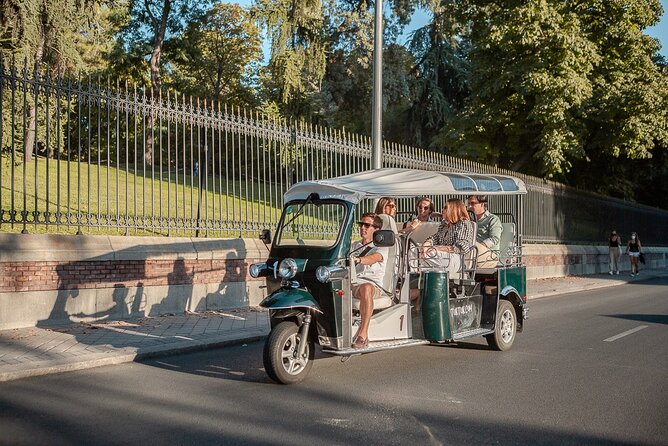
From there, the tour shifts toward city landmarks that are easy to remember and easy to find later.
Puerta de Alcalá
Puerta de Alcalá is one of Madrid’s old royal gates. The tour describes it as one of five gates that once gave access to the city. It is located at the center of the Independence Square roundabout, which means even if you only remember the sight and not the exact route, you can still locate it.
This is a great stop when you want an “I will find this again” landmark. Madrid is easy to get around once you start recognizing these reference points.
Plaza de Santa Ana
Then you have Plaza de Santa Ana, an open space in the Cortes district dating back to 1810, with repeated urban changes over time. This kind of stop is useful because it reminds you Madrid is not frozen in one era. It keeps rebuilding and reshaping, even while keeping certain anchors.
If your next day includes wandering through neighborhoods around Cortes, this stop helps you orient.
Almudena Cathedral and its museum area
Almudena Cathedral is presented as Madrid’s most important religious building. It was consecrated on June 15, 1993 by Pope John Paul II, and it is noted as the first cathedral consecrated outside Rome.
There is also a museum connected to the cathedral, with objects that tell the history of the diocese of Madrid. The tour mentions rooms with mosaics and episcopal shields, which tells you the museum is not just a casual add-on.
If you care about symbolism and ceremony, this is one of the stops that tends to land. Even if you do not enter the museum, the cathedral context gives meaning to what you see in the surrounding area.
Royal Palace Views, Sabatini Gardens, and Temple of Debod
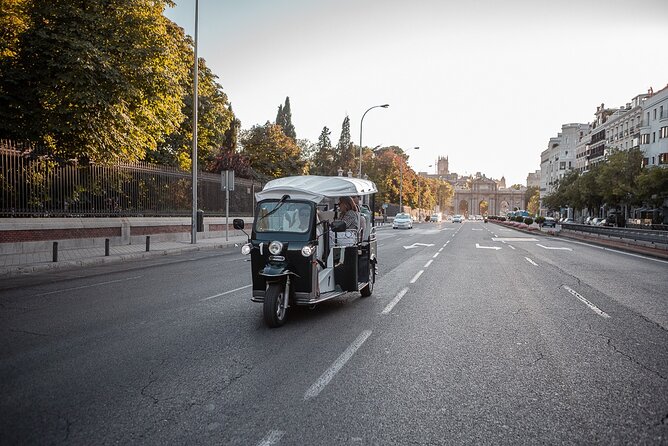
Near the end, you circle back into Royal Madrid, then finish with an ancient contrast.
Royal Palace of Madrid and state ceremonies
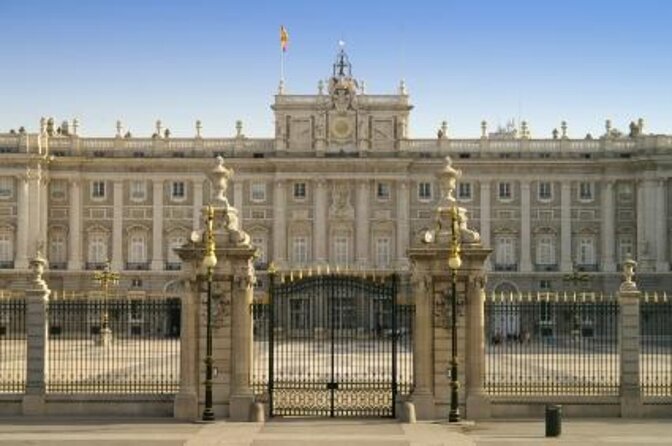
The Royal Palace of Madrid is described as the official residence of the king of Spain, even though current kings do not live there. It is used for state ceremonies and solemn acts, which makes it a place where tradition shows up even when everyday life is happening elsewhere.
This stop is also helpful because it sets the “top layer” geography of the city. If you end your Madrid trip with a final walk, you will already understand how the area fits together.
Sabatini Gardens
Opposite the northern facade are the Sabatini Gardens, covering about 2.66 hectares. Even if you only glimpse them from the route, it is a nice reminder that Madrid’s royal zone is not only stone and formal buildings. There is green space right there too.
Templo de Debod
Finally, you reach the Temple of Debod, an ancient Egyptian building in Madrid. The tour notes it is located west of the Spanish Steps, near Paseo del Pintor Rosales, on higher ground where the Mountain Barracks was once located. Admission is listed as free, and the visit is around 10 minutes.
This is the kind of stop that makes a tuk tuk tour feel special. You end with an unexpected flavor: Egypt in the middle of Madrid, which is a great memory for a short tour.
If you time it well, this can also be a good spot for calmer photos when the streets feel less crowded.
Comfort and Practical Details That Matter More Than They Sound
This is where the “small” inclusions can actually make or break your experience.
Blankets and protective layers are included, which is a big deal in Madrid because winter days can be cold and breezy. You are outdoors for photo moments and short stops, and it is those moments that decide whether the tour feels comfortable or miserable.
The tour runs in rain or heat, and it can be canceled only under extreme conditions. That sets expectations: you should plan with the idea that weather is part of the day, not an automatic reason to stop.
Tuk-tuks are described as suitable for older people, and drivers will help get on if needed. That makes it more family-friendly than many similar rides.
Also, you get a mobile ticket and English is listed. If you are traveling as a non-Spanish speaker, that helps you relax, because you are not hunting for translations at every stop.
Tour Guides and the Difference Good Storytelling Makes
The quality of a city tour often comes down to the person at the microphone. This experience is built around an expert companion guide and a driver-guide, and the standout guides I have heard mentioned by name tend to combine friendliness with clear explanations.
Names like Enrique and Juan Carlos come up for being amazing and enriching. Carlos is praised for friendly city storytelling. Christian shows up for being great and for making it feel more personal than a sightseeing bus. Laura is noted for being brilliant and enthusiastic, and Roberto gets credit for being informative and accommodating with great trip flow.
What matters for you is not the name. It is the effect. When the guide can answer your questions patiently and connect the dots between monuments, your “overview” turns into a useful map in your head.
Who Should Book This Eco Tuk Tuk Madrid Welcome Tour
This tour is a strong choice if:
- You are in Madrid for a short stay and want to see big highlights fast.
- You want a low-walking way to get bearings before you plan museum time.
- You like photos but do not want to spend the day figuring out where to stop.
- You are traveling with older adults or anyone who benefits from a vehicle between stops.
It may be less ideal if you:
- Want long interior visits and deep museum time during the same day.
- Get overwhelmed by lots of information in a short window. Some people note that after a full hour or more, they needed time to process what they saw.
Should You Book This Eco Tuk Tuk Madrid Welcome Tour?
Yes, if you want an efficient, comfortable, and guided introduction to central Madrid. The value is in the combination: electric transport, smooth start without queues, included weather gear, and a route that hits the places you will likely circle back to later.
Book it especially early in your trip. You will leave knowing where the Royal Palace zone is, what the Prado area feels like, why Almudena is a landmark, and how the city’s grand squares connect. Then you can build the rest of your days with more confidence, and fewer backtracks.
Recently reviewed around Madrid
- Tour en Tuk Tuk por lo mejor de Madrid★ 3.4 · 13 reviews
- From Madrid: Toledo Day Trip with Cathedral and 8 Monuments★ 4.3 · 32 reviews
- From Madrid: Toledo Guided Day Trip with Cathedral Admission★ 4.4 · 79 reviews
- Madrid: Tasty Tapas Tour & Visit to a Terrace with Views★ 4.5 · 118 reviews
- Madrid: Spanish Tapas Tour★ 4.3 · 7 reviews
- From Madrid: Best of Sevilla Day Tour with Train Transfers★ 4.6 · 40 reviews
- Tapas Food Tour with Dinner in Madrid★ 5.0 · 6 reviews
- Small Group Prado Museum Guided Tour with Skip the Line★ 4.2 · 106 reviews
Madrid Tuk-Tuk Tours, compared.

Madrid Historical Tour with Local Guide in Eco Tuk Tuk Private
Read our review →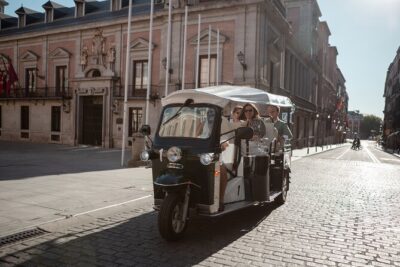
Madrid Express Tour with Local Guide in Eco Tuk Tuk Private
Read our review →
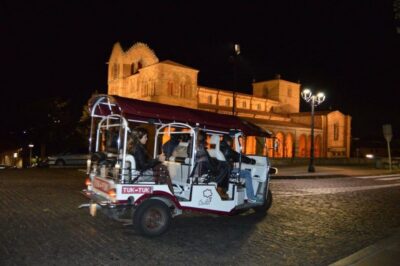
Tour Guiado En Tuk Tuk Recorre Avila De La Forma Mas Comoda
Read our review →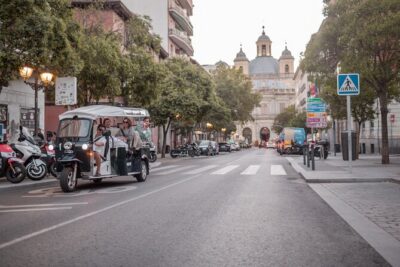
Madrid Expert Tour with Local Guide in Eco Tuk Tuk Private
Read our review →
Madrid Expert Plus Tour with Local Guide in Eco Tuk Tuk Private
Read our review →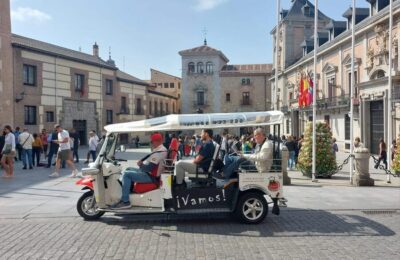
Browse the lists this tour appears in