
Reviewed · MADRID TUK-TUK TOURS
Madrid Expert Tour with Local Guide in Eco Tuk Tuk Private
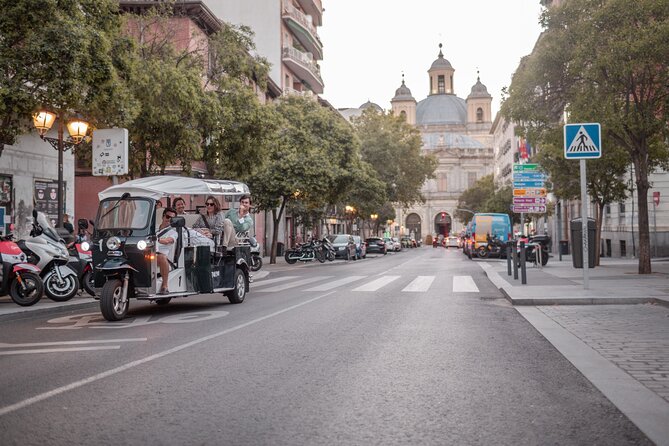
Madrid by electric tuk-tuk is a fun idea because it trades long walking for quick, safe hops between landmarks. You get a private ride, plus a guide who can explain what you are seeing as you roll past it. It is also built for real weather, with blankets and protective layers when Madrid turns chilly.
Two things I especially like are the fast orientation and the way the route mixes classic Madrid with big modern stops. In practice, it is the kind of tour where you come away knowing where the museums are, where the Royal Palace area sits, and which squares anchor the city. One possible drawback is that the stops for photos are fixed and the route can shift only due to street closures or demonstrations, so you cannot customize the timing on the fly.
Key takeaways before you book your Eco Tuk Tuk Madrid ride
- Private, 100% electric ride: your group stays together in a sustainable vehicle.
- Fast Madrid orientation in about three hours: ideal for planning the rest of your trip.
- Guide-led photo planning: pre-selected photography stops keep things efficient.
- Weather-ready comfort: blankets and protective layers help you stay outside longer.
- A sweep from Atocha to the Royal Palace area: you see the city’s structure, not just random stops.
- Small-group vehicle limits: up to 4 passengers per tuk-tuk, so larger groups may use multiple tuk-tuks.
A fun, efficient way to see Madrid in about three hours
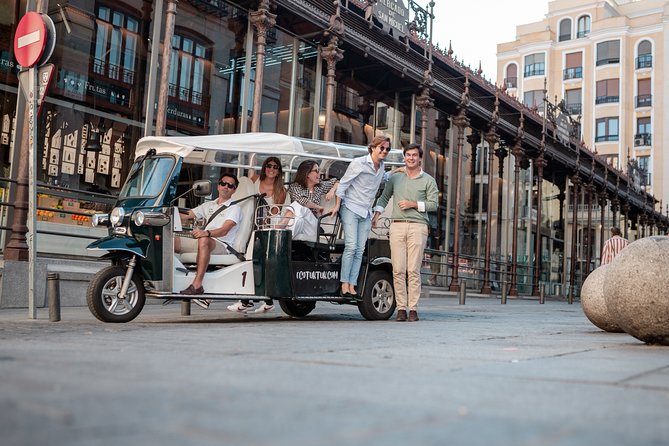
This tour is interesting because it is built for getting your bearings without feeling rushed. You ride in an Eco Tuk Tuk that is designed to be comfortable even when the city streets get crowded. And since it is private, you get more room to ask questions instead of waiting for a group voice.
I also like that the pace is simple: you are not stuck doing a marathon on foot. The plan is made for a quick overview, with short viewing moments and photo breaks at pre-arranged spots. That matters if this is your first day in Madrid and you want to map out your next moves.
The second big plus is the comfort factor. Madrid can be windy and cool, and the tour includes blankets and protective layers so you are not miserable during outside stops. One smart detail is that the vehicles are meant to be easier for older people too, with drivers ready to help you get on if needed.
More tuk-tuk tours in Madrid:
- Madrid Welcome Tour with Local Guide in Eco Tuk Tuk Private
★ 5.0 · 2,936 reviews - Madrid: Private City Tour by Eco Tuk Tuk
★ 4.9 · 2,876 reviews - Madrid Historical Tour with Local Guide in Eco Tuk Tuk Private
★ 5.0 · 876 reviews
Where you meet, and the practical pickup tip near the Royal Palace
Meeting point matters more than people think, because Madrid has lots of stairs and underground passages. Your stated start point is C. de Bailén, 4 (Centro, 28013), and the tour ends back at the meeting point.
The pickup itself is described as being near the Plaza de Oriente area by the Royal Palace, in the underground bus station next to the palace. Calle Bailén may not show a visible number 4, so the practical trick is to search Google Maps for Calle Bailén 4 or Puerta del Príncipe. On the ground level, you are looking for the stairs that connect to the station, then the signboard for the Eco Tuk Tuk team.
If you have mobility concerns, you are expected to contact them ahead of time by phone or WhatsApp, so they can help you access the meeting point by elevator. This is one of those small operational details that can make or break a tour day.
How the ride is set up for private groups, and who it suits best
This is a private tour/activity, meaning only your group participates. The tuk-tuks are reserved based on how many people you have, with a legal maximum of 4 passengers per tuk-tuk. If your group is larger, you may use multiple tuk-tuks, but the idea stays the same, you are not sharing with strangers.
The tour is offered in English, and you will receive confirmation at booking time. Minimum age is 2 years, and babies are not allowed. There is also a minimum weight requirement of 9 kg, which is worth checking if you are traveling with a small child.
I also think this fits very well if you are traveling as a couple, a family, or with teens who want to move fast but still hear real explanations. Multiple guides mentioned by the company have a knack for keeping things lively and easy to follow, with English that stays clear and natural.
Covered market and Atocha Station, the Madrid “how it works” stops
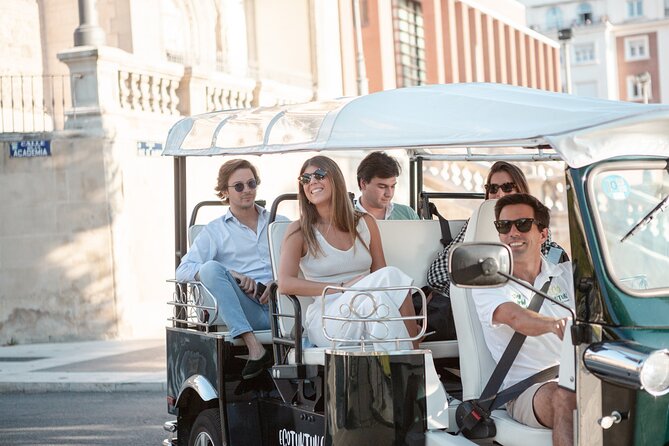
You start with an area that sets the tone for local life. The covered market from around 1916 is a good stop because it shows Madrid as a city of food, errands, and everyday social energy. Even if you do not go inside for a full meal, the setting helps you understand what local eating habits look like.
Then you roll toward Atocha Station, a major rail complex and a huge hub for trains in Spain. It is one of those places where Madrid’s size becomes real. Atocha also sits near Plaza del Emperador Carlos V, so it is a practical connector point for landmarks.
This kind of early “function” stop is useful. It tells you where major transit corridors are, and that helps later when you plan trips to museums, neighborhoods, and day excursions.
Still in Madrid, a different sort of afternoon:
- Madrid: Tour Bernabéu Entry Ticket
★ 4.5 · 21,573 reviews - Madrid: Prado Museum Entry Ticket
★ 4.6 · 17,509 reviews - Madrid: “Emociones” Live Flamenco Performance
★ 4.8 · 12,866 reviews - Madrid: Panoramic Route City Tour
★ 4.1 · 12,259 reviews
Spanish Courts and the story behind the big stone door
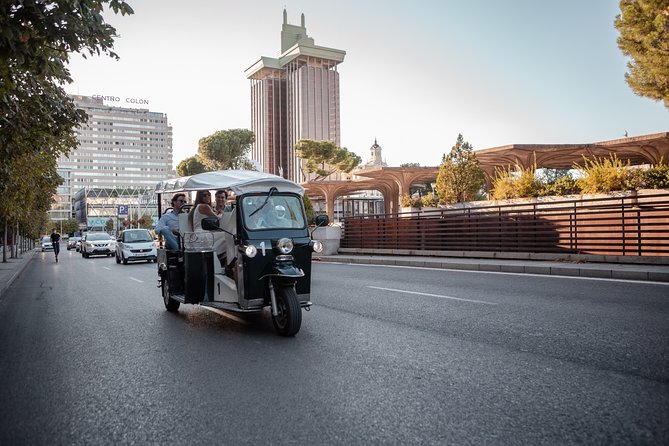
The tour takes you past the Palace of the Spanish Courts, built on the site of an older convent. The building’s face is a strong example of how Madrid blends religious past with political power, and your guide can connect the architecture to the city’s timeline.
One highlight in this area is the detailed facade, including the neoclassical portico with tall columns and the emblematic lions at the entrance. There is also a famous bronze door that opens only on very marked occasions, which is the kind of detail that makes the building feel real instead of just “another impressive government building.”
You also get context around the building’s past purpose, since it served as the seat of Congress for a stretch in the 1800s. And if you notice room names, the best-known session chamber is something the guide can point out, along with other notable spaces such as the conference room nicknamed the lost steps room.
Neptune Fountain and Puerta de Alcalá, classic city geometry in real time
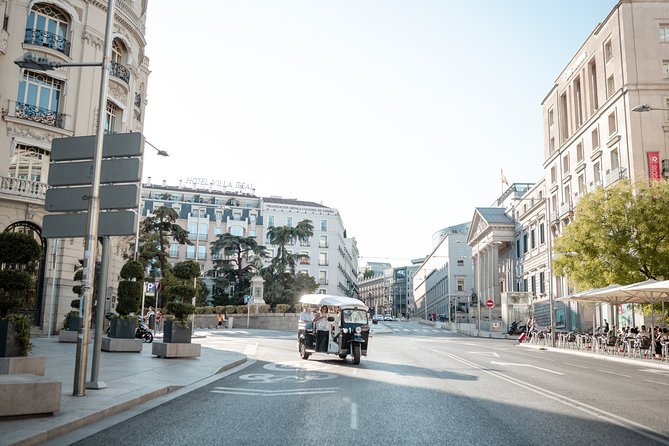
Next, you hit Plaza de Cánovas del Castillo and the Fountain of Neptune, the monumental centerpiece of that roundabout. It is one of those landmarks Madrid uses to organize traffic and also to create a visual “pause.” In photos, the fountain works because it gives you symmetry and a clear focal point.
Then comes one of Madrid’s postcard symbols: Puerta de Alcalá. This triumphal neoclassical arc, designed by Francesco Sabatini, was built to replace an older gate and was inaugurated in 1778. The details matter here, because the gate has five openings rather than the usual three you might expect.
The guide can also explain the difference between the two sides of the structure, since the decoration shifts depending on whether you are looking toward the city or toward the outside. It is not just a big gate, it is built like a message.
Prado area and Los Jerónimos, art-adjacent stops you should connect
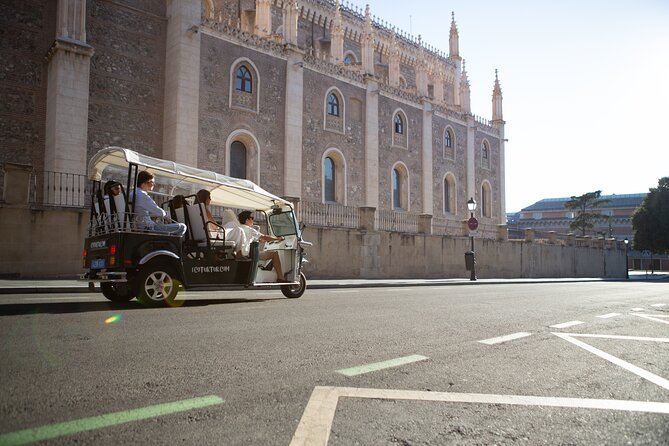
Your route includes the museum zone around the Prado and the nearby church San Jerónimo el Real. Even if you are not buying a museum ticket right then, you are getting the crucial context: this area is the heart of Madrid’s visual arts identity.
The Prado connection is strong for a reason: the museum is known for major European painting across centuries, including artists like Velázquez, El Greco, and Goya. When you stand nearby, it helps to know why the city treats this as a flagship. Your guide can point out which painters are most represented and why they matter.
Then you step to Los Jerónimos, a late Gothic parish church with Renaissance influences from the early 1500s. It is closely connected to Spanish royalty through its long relationship with kings and queens, and it is also near the Prado.
I like this pairing because it gives you a deeper sense of place. Instead of only thinking Prado equals art, you see how religious sites and royal traditions feed into the same Madrid story.
Barrio Salamanca streets and Bernabéu along the Paseo de la Castellana
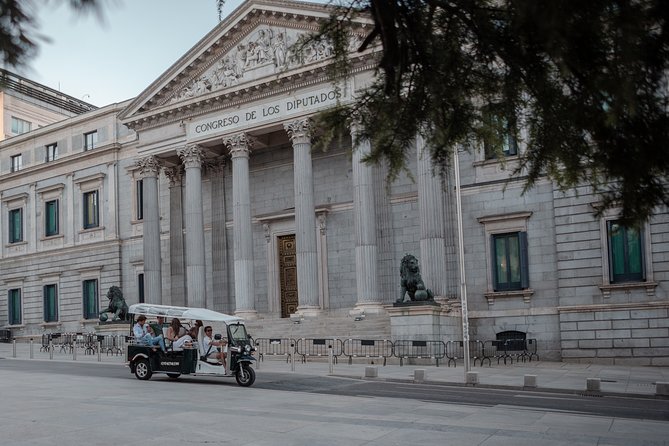
The tour shifts from old-city gravity to Madrid’s more polished, modern identity. You travel through the Barrio Salamanca streets, including Velázquez, Ortega y Gasset, and Serrano. This is where you feel the city’s “designer Madrid” energy, even if you are just passing by.
Then you head toward the Santiago Bernabéu stadium. It is a big landmark with global recognition, and it sits on the Paseo de la Castellana route. The stadium was inaugurated in 1947 and today holds 81,044 spectators.
A tour stop at Bernabéu can feel like a fun detour, but it also works as orientation. Madrid is not only royal and museum-focused. It is also a sports capital with a huge public identity built around the team.
If football is part of your trip, this tour is a quick way to place Bernabéu on your mental map. Later, if you want a longer visit, you will know exactly where to head.
Columbus, the National Library, and the big-city feel of Madrid’s center
From there, you roll toward Plaza de Colón, where a Christopher Columbus monument rises in white marble. It has a neo-Gothic style and is set on an imposing carved pedestal, built in the late 1800s for royal wedding celebrations. It is a dramatic focal point because it sits at the center of a traffic-and-visual system.
The same zone includes the Gardens of Discovery, a park opened in 1970, with sculptural highlights. There is also a cultural center in the basement of the area, tied to the city’s public programming.
You also pass the National Library of Spain (BNE), an important institution that preserves Spain’s published heritage. The BNE holds around 30 million publications, and it uses museum and exhibition halls to share collections with the public. Even if you do not go inside, knowing what it is helps you understand why this part of Madrid feels official and serious.
Plaza de Cibeles and the Bank of Spain area, where Madrid celebrates
One of the most iconic stops is Plaza de Cibeles and its famous fountain. The sculpture represents Cibeles, the Roman goddess tied to land, agriculture, and fertility. Lions pull the carriage-like base, and that dramatic animal detail is exactly what makes Cibeles a top photo target.
Real Madrid fans treat this as a celebration symbol, so the fountain is not only art. It is a public meeting point for big wins and big emotion.
Nearby, you pass the Bank of Spain area. The building’s exterior is designed to look like it fits the importance of national finance, and it was built with the idea of being the seat for coin and bill issuance. The interior is limited for visits, and access is described as being primarily through educational groups or certain cultural and associative entities.
I see the value in this stop even without an interior visit. It helps you understand what “center of power” looks like in Madrid, because the buildings around Cibeles have a formal, monumental tone.
Plaza de Santa Ana, San Francisco el Grande, and the Almudena Cathedral
Next comes more old-town atmosphere. Plaza de Santa Ana, dated to 1810 and shaped by multiple rounds of urban development, gives you that classic Madrid square feel. It is a good spot to slow down mentally, even if you are still in ride-and-stop mode.
The tour also includes the Royal Basilica of San Francisco el Grande, officially the Basilica of Our Lady of the Angels. It sits in the Palacio neighborhood, inside Madrid’s historic center. Churches like this often feel like “a quiet pause” after busy streets, and your guide can connect what you see to how the city’s spiritual life evolved.
Then you reach the Almudena Cathedral, Madrid’s key Catholic cathedral. It was consecrated on June 15, 1993 by Pope John Paul II, and it became the first consecrated cathedral outside Rome. There is also a museum component with multiple rooms that tell the diocese story through objects and displays.
If you want a practical tip, plan a little extra time for the cathedral area. Big religious buildings can be visually intense, and you will get more out of it if you are not just rushing through.
Royal Palace viewpoints and Campo del Moro, Madrid’s official grandeur without the marathon
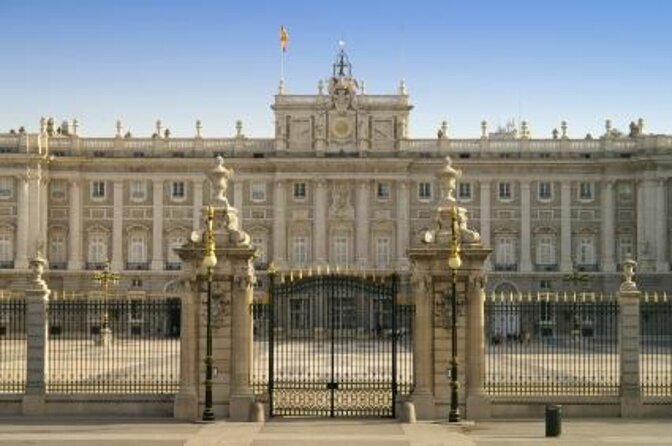
The tour spends time in the orbit of the Royal Palace, also called the Palacio de Oriente. Construction began in 1738 and lasted 17 years, and Carlos III established his habitual residence there in 1764. The palace sits on the same location where an earlier palace burned down in Christmas Eve of 1734.
This stop is a “big picture” moment. Even from the outside, you can feel why this is a central Madrid symbol. You also get access to the Campo del Moro gardens and the nearby Sabatini gardens area, with Campo del Moro noted as visitable during the day.
One more practical note: a rose garden stop can appear as a favorite for many groups in this area, so keep your eyes open for a quick flower-photo moment when the day and timing cooperate.
Temple of Debod to close, a calm contrast right by Plaza de España
The tour includes Templo de Debod, an ancient Egyptian temple building currently located in Madrid. It is located west of Plaza de España, next to the Paseo del Pintor Rosales, on a hill where the Mountain Barracks once stood.
This stop is short, about 15 minutes, and the admission is free. I like this ending because it breaks the pattern. After royal palaces and cathedral architecture, you get an Egyptian moment that feels different and more reflective.
If you are the type who likes sunset-style photos, Debod is often a good bet. Even if it is not the literal sunset, it helps reset your eyes after hours of stone and sculpture.
Price and value: is $28.67 per person a good deal?
For $28.67 per person, the best way to think about value is not the ticket price alone, it is time saved and explanation gained. This tour is timed for an overview of major highlights in a short window, about three hours, and it is private to your group.
You also get specific “comfort value” included: blankets for cold weather, and protective layers for wind. Add in the fact that the ride is electric and that the tour is designed to start without the worst queues and waiting, and the cost starts to make sense for people with limited time.
The other value angle is social. Since it is private, your group can ask follow-up questions in real time, rather than only hearing broad commentary. Multiple guides known to work this route have been described as friendly and able to keep a smooth pace, including people like Jaime, Juli, Lucia, Carlos, Manuel, Gustavo, Alejandro, and Juan in the experiences shared with the company.
Should you book the Madrid Eco Tuk Tuk private tour?
Book it if you want a smart first look at Madrid, especially if you have limited time and you like history explained in a relaxed way. This is also a good fit if you do not want to suffer through hours of walking, but still want to hit the big visual anchors like Prado zone, Royal Palace area, Almudena Cathedral, and the Cibeles fountain.
Skip it if you want a highly flexible itinerary where you can linger at museums for long periods or change photo stops on demand. This tour uses fixed photography stops and a set route, with route changes only for closures or demonstrations.
If your goal is orientation and a comfortable, scenic overview with an English guide, this is a strong option to start your Madrid trip.
Recently reviewed around Madrid
- Tour en Tuk Tuk por lo mejor de Madrid★ 3.4 · 13 reviews
- From Madrid: Toledo Day Trip with Cathedral and 8 Monuments★ 4.3 · 32 reviews
- From Madrid: Toledo Guided Day Trip with Cathedral Admission★ 4.4 · 79 reviews
- Madrid: Tasty Tapas Tour & Visit to a Terrace with Views★ 4.5 · 118 reviews
- Madrid: Spanish Tapas Tour★ 4.3 · 7 reviews
- From Madrid: Best of Sevilla Day Tour with Train Transfers★ 4.6 · 40 reviews
- Tapas Food Tour with Dinner in Madrid★ 5.0 · 6 reviews
- Small Group Prado Museum Guided Tour with Skip the Line★ 4.2 · 106 reviews
Madrid Tuk-Tuk Tours, compared.
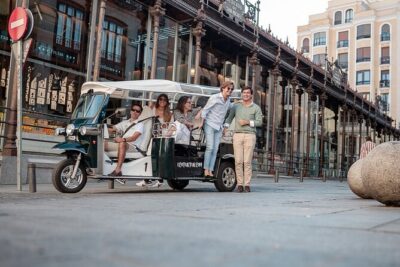
Madrid Welcome Tour with Local Guide in Eco Tuk Tuk Private
Read our review →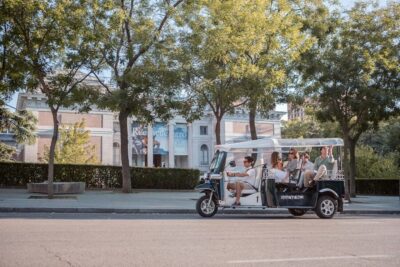
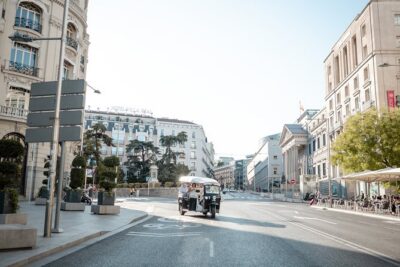
Madrid Historical Tour with Local Guide in Eco Tuk Tuk Private
Read our review →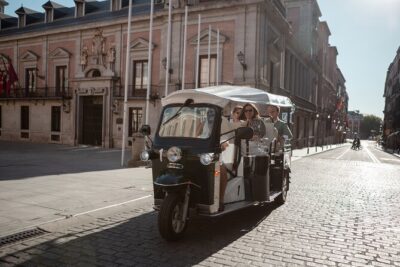
Madrid Express Tour with Local Guide in Eco Tuk Tuk Private
Read our review →
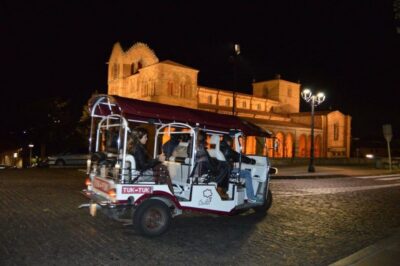
Tour Guiado En Tuk Tuk Recorre Avila De La Forma Mas Comoda
Read our review →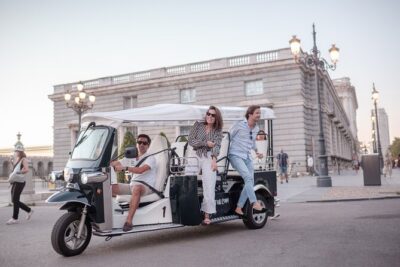
Madrid Expert Plus Tour with Local Guide in Eco Tuk Tuk Private
Read our review →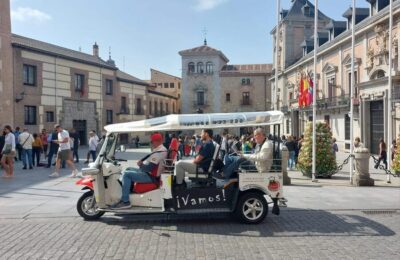
Browse the lists this tour appears in